
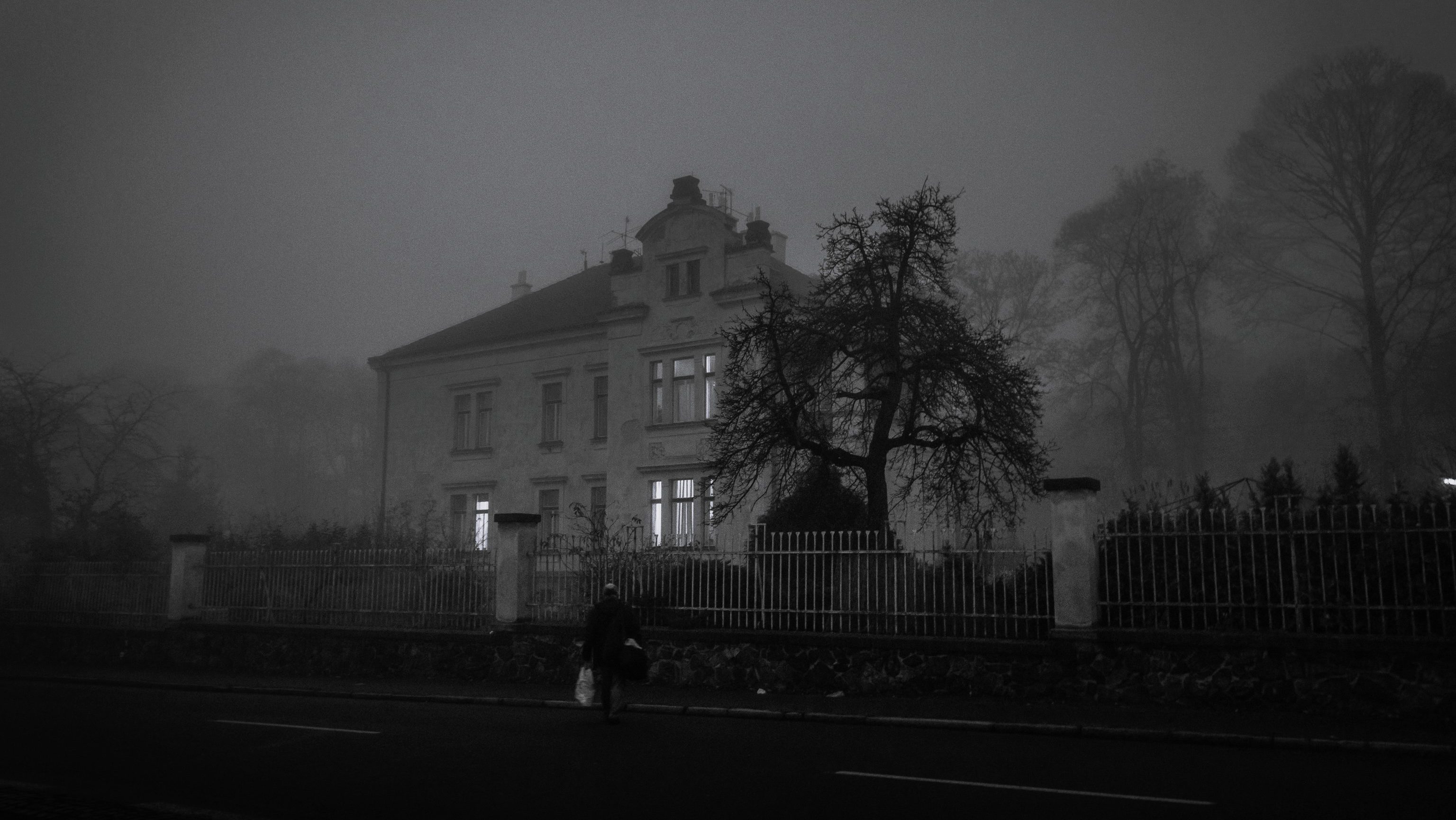
Echoes
by S. J. Baker
“Danger”, the notice said. “This is a construction site. Keep out.” Underneath, a black stick figure in a circle had a red line cutting through it. “No Trespassing”.
But this was Elijah’s street. He’d grown up here. The old nursing home had been closed when he was only a toddler, but he and Jez, from four doors down, had long ago discovered the gap in the fence. They knew every scraggy tree, every tangle of undergrowth, every crooked paving slab in the neglected grounds.
They’d never been inside the buildings, though. The doors were all blocked with sheets of shiny steel and the ground floor windows had wooden boards nailed across them. Higher up, windows were cracked and broken where older kids had competed to lob carefully aimed stones, but they were far beyond Elijah’s reach.
Elijah had always wanted to see what it was like inside.
He’d heard stories, of course. Fragments of stories. When they thought he wasn’t listening, grown-ups talked darkly about “bad times”, shaking their heads over what had gone on behind the doors of the nursing home before it was closed down. When he was quite small, Elijah had heard his own parents arguing about staying in the street, his mum’s voice distressed and sharp, his dad insisting that the past was done with. Besides, he had reminded her, moving cost money, and they were only just making ends meet. Hadn’t they always been happy here? And it was so well placed for when Elijah started school. In any case, if they wanted to sell up, wasn’t it better to wait until the headlines stopped and the scandal was forgotten?
Elijah, busy on the landing with his toy cars, had peered through the bannisters at the top of the narrow stairs. What did they mean, they might leave the house? They’d always lived here. He liked it here. So, when his mum shrugged her shoulders unhappily, and his dad put his arms around her and told her she was worrying about nothing, Elijah had picked his toy fire engine up again, pressed the button that made a siren noise, and driven it back into his bedroom.
There had been no more talk of moving, although Elijah’s mum still crossed the road rather than walk too close to the empty nursing home. The net curtains that hung in the sitting room were more to keep out the view of the sad building opposite than to stop passers-by from looking in. She had been relieved when the barriers went up, and notice of demolition was given.
In the meantime, Elijah’s primary school years had stretched out forever. Now, suddenly, it was Sunday afternoon, the last day of the summer holidays, the last day before he started at big school. His mum had made him try on the uniform again that morning, and now it lay, laden with threat and promise, on the chair in his bedroom, the blazer too big for him, the shirt collar and tie stiff with unfamiliar formality after the soft sweatshirt of his primary school. Jez would be starting with him, but this was one of Jez’s weekends with his dad, and he wouldn’t be back until evening.
The street was quiet. Elijah squinted through the metal screens that had been erected around the site. Nothing moved in his thin line of vision. He looked up at the notices again. Next to the sign that said “Danger” was yet another, in heavy black print on a bright yellow background: “Parents are advised to warn children of the dangers of entering this site”.
He stood, his head on one side, considering. Elijah wasn’t a child who habitually broke rules. He didn’t like that feeling of being in trouble, that moment when your stomach lurched, and your heart sank, and your forehead tightened, and you knew someone was going to be cross with you. But they had been through the fence so often, him and Jez, that finding a way through these new barriers didn’t feel like doing something wrong.
He crossed back to the other side of the street, kicking a discarded Pepsi can as he went. Thin brown liquid trickled out as it spun round on the road, leaving a dark spiralling stain on the tarmac. Mum always grumbled at litter on the street, as if anything dropped near their front door had been aimed at her personally. Elijah picked up the can and placed it carefully next to the front doorstep. He’d put it in the kitchen bin later.
The warmth of a late summer afternoon had settled on the empty street. Somewhere above him a seagull called. A fly buzzed drowsily over the trail of drink on the road. Elijah made up his mind.
***
He stood in the little alley that branched off his street, dividing the grounds of the old nursing home from the next stretch of terraced houses. No one would see him here. The yellow barrier, with the same warning notices, continued down the length of the alleyway. If he pushed at the point where its sections joined, they gave a little.
The gap he made was small, but so was Elijah. He’d been hoping all summer that he’d start to grow, reaching the same height as many of the other boys starting at his new school, but no – he was still one of the shortest in his class. His dad, all six feet of him, told him not to worry; it had been the same for him until he was about fourteen, and then he’d overtaken all the lads who had once towered over him. “You’ve got the same genes as me, my boy,” he’d said. “You’ll get there.” But Elijah didn’t want to get there some vague time in the future; he wanted to be there now, so he didn’t look like a little kid when they lined up in the playground tomorrow.
He knelt down, pushed at the barrier, and crawled through the gap, using his shoulders and hips to keep it open until he was through, then let it fall shut behind him. Taking a quick look around, he clambered to his feet, brushing the dust from his jeans.
A pigeon fluttered away from him as he stood up, flapping its wings indignantly, then settled a few yards off and went back to pecking at the dry ground. Elijah knew exactly where he was: in the far corner of the grounds, away from the buildings. To his left was the den he and Jez had built in the depths of a rhododendron bush. Fallen yellow fruit from a plum tree lay rotting on the ground nearby, and he remembered the sweet, tangy taste of the fruit as they had eaten it earlier that summer, sucking at the soft flesh and seeing who could spit the stones the furthest.
In front of him, a tangle of ivy and brambles smothering an old rose bed hid the nursing home itself from sight.
Perhaps he should wait for Jez. Perhaps they could come back together tomorrow, after school, after the builders had packed up for the day. Elijah’s mouth was suddenly dry.
He pressed his lips together in a thin line. He would do this. He would do this, and tomorrow he would have something to say, a story to tell, to anyone who thought he was just a little kid who hadn’t started to grow yet.
Straggling tendrils of goosegrass snagged at his jeans, its sticky seeds clinging to him. If Jez were here, they’d be chucking it around, trying to make it stick to each other’s clothes. He ploughed through the long grasses that skirted the overgrown flowerbed, and there it was.
The old nursing home. It was three storeys high, higher than the houses that surrounded it. Elijah had seen it countless times, but never like this.
The walls facing the garden had been completely demolished. Where there had once been steel-plated doors and boarded-up windows, there was now empty space – allowing Elijah to see right into the interior. It stood open to the world like the rooms in one of those old-fashioned dollhouses his cousin had – except here, the edges weren’t neat and finished. Giant, savage bites had been taken out of the brickwork, leaving wires trailing and chunks of concrete hanging and dust rising in little puffs from the top floor where there was just a breath of wind.
There was nothing to stop Elijah from getting in.
***
He scrambled over a pile of bricks and rubble to reach the concrete floor of the nearest room. The ceiling blocked out the sun, and after the brightness of the overgrown gardens, the room was shadowy and obscure. He peered into its depths and made out a door on the back wall.
The room was quite large. Nothing was left to show what it had been used for; bare wires hung from the ceiling where light fittings had been wrenched out; a forlorn cable trailed from a wall socket and lay across the floor like a dead snake. Grey mould clung to the walls in abstract patterns and debris crunched under Elijah’s feet as he took a few cautious paces towards the shadows. Once he turned, looking back at the sunshine and the garden, the intriguing, closed door ahead of him – along with thoughts of the story he might have to tell tomorrow – urged him on.
The air was cooler here, near the back of the room. The sun would never reach this far inside. He reached forward, taking hold of the metal handle, and was surprised at how cold it felt.
He pulled the door towards him. It stuck, shifting reluctantly over the gritty concrete, its wood swollen with the damp of years. He tugged at it, dragging it across the floor until there was a gap wide enough for him to squeeze through.
A tiled corridor stretched ahead of him. Elijah could make out a faded pattern of brown and yellow diamonds beneath his feet. Doors were spaced evenly along the walls on either side, leading into other rooms. He shivered. It was even colder here, as if summer had never reached it, never found its way into the windowless innards of the building.
Glimmers of light came through the open door behind him, but not enough to reach to the end of the corridor, which disappeared into murky darkness. He had had enough now – he wanted out of the cold and the gloom, so he would peek through just one of these doors and then he would leave.
The cold air pressed on him. He could almost imagine it feeling for him with icy fingers, pressing into the soft flesh of his bare arms. As if someone had taken hold of him.
He shivered and shook away the thought. He had reached the first door on his right, the number 3 just visible in the dim light. He reached for the handle. Its surprising warmth in the chill air made him change his mind, draw his hand back, glance down the corridor – and the shadowy darkness seemed to bulge and swell, lurching down the passageway towards him, a wave of cruelty and malevolence. He wrenched at the door handle, tumbling through into the room beyond, and slammed the door behind him.
He leant against it, panting, his cheek pressed against the cracked paint, straining to hear through the flimsy door. His breath was shaky, visible in front of him in little droplets of steam. His heart thumped in his chest against his thin t-shirt. He was back in the playground at school, in the lonely days before he’d found Jez, when one of the older boys had decided to have some fun with him and Elijah had faced every playtime with a humiliating, fear-drenched dread that he had never been able to tell anyone about, teacher or parent – a sense that out there, on the innocent tarmac, was something that took pleasure in pain.
He could hear nothing from the corridor. He let out a breath and turned, pressing his back against the door.
The light in this room was green-tinged, filtering through the creeper which curtained the window. The demolition crew hadn’t reached this part of the building yet, and all four walls were intact. It was empty of furniture, except for a plastic-covered armchair sitting in its centre.
That was empty too. Elijah was sure it was empty; his eyes told him it was, but the sense of a presence – of someone there – was overwhelming. Misery spun invisible webs around it, the air was heavy with it, his bare skin prickled with it, and it wasn’t just misery, there was helplessness too, and that playground fear that Elijah knew from deep inside him, and then a crackle of impotent rage, forking through the room like lightning, pinning Elijah against the door, trapping him in this room with something more terrible than he had words to describe. He couldn’t turn his back on that chair and he fumbled behind him for the handle, still eerily warm, and although the room was heavy with silence something vibrated in the air, as if someone had just let out a cry and its echoes still lingered in the room, echoes which throbbed against Elijah’s ears until he couldn’t bear it, and his fingers closed around the handle and he dragged the door open, slamming it shut behind him as he tumbled through into the corridor.
The darkness was complete. There were no more glimmers of light from the door he had left open. In utter terror now, pursued by the memory of those shadows, that room, that chair, Elijah stumbled up the corridor, his left hand feeling the wall to guide him, his right held out blindly in front of him to stop him crashing into the door when he reached it.
But when at last his groping hand met the door, it was closed – a blank face of wood set firmly in its frame – and even as Elijah refused to believe it, even as he knew that no wind could have blown that door shut, could have tugged it over the uneven floor, he knew too that whatever he had found in this place was not willingly letting him go.
He felt with panicky hands for the handle, grabbing it, twisting it and pushing the door outwards, as the hairs on the back of his neck bristled and his skin contracted at the awareness of something behind him, something desperate and yearning and unforgiving. The door moved with agonising slowness, grinding against the floor, jamming on debris, letting through a crack of light, as Elijah pushed and heaved and sobbed, until finally he was able to squeeze through.
He sprawled forwards and fell heavily, dragging himself up again and running for the light, the sun-drenched, overgrown garden where he and Jez would never play again. He fell once more on the bricks that littered the threshold, ignoring the sharp edges that jabbed at him through his jeans and scraped his bare arms to scramble up again and keep running. He skidded on the rotting plums, wheeling his arms to stay upright, before he thudded against the barrier he had come through – in a different life, it seemed – and came to a juddering halt.
Fearfully, so near the normality of the street, he turned and looked back towards the nursing home. The warmth of a late summer afternoon drowsed over the garden. A pigeon – was it the same one as earlier? – pecked at the ground a little way away. A bee had found its way through the brambles to one of the surviving roses and buzzed contentedly around its petals.
***
“Aren’t you hot in that hoodie?” said his dad that evening over supper. Dad’s face was shiny with the heat, and there were dark semicircles of sweat under the arms of his short-sleeved shirt. He pursed his lips and puffed his cheeks, blowing his breath out in a long and noisy gust. “Hotter than ever this evening. And there you are all wrapped up as if it’s winter.”
Elijah shrugged.
“Your Leavers’ hoodie,” said his mum, piling up the plates, clattering the knives and forks together. “I haven’t seen you wearing that since you brought it home after your last day at Wyeford.” She smiled. “I’m glad it’s getting some use, but I’m with Dad – you must be sweltering.”
Elijah shrugged again, and she looked at him more closely. “You’re very quiet, love,” she said. “Worried about tomorrow?”
Elijah looked down at his placemat and shook his head. “No. I wasn’t really thinking about it.”
“It’ll be fine, you know,” she said. “Jez’ll be there too.”
“Yeah,” he said.
“The first day’s the worst. After that you know what to expect. And you’re all ready,” she went on. “Uniform all laid out. The letter said to bring your PE stuff tomorrow, didn’t it? Your kit’s named and ready.”
“Yeah,” he said again. His parents exchanged a look and changed the subject.
Elijah helped with the drying up, then checked his new phone before heading up to his bedroom. His parents had agreed to his getting a smartphone, now he was starting at secondary school, but he had to keep it downstairs. Strictly no online stuff in his bedroom.
There was a single text message from Jez: “hi m8 cu tomoz.”
No, he wanted to reply. No, I’m not coming tomorrow. Instead, he sent a thumbs up and left the phone on the kitchen table.
In his room, he looked once more at the uniform, laid out on the chair. On the floor next to it, in a black holdall, was his PE kit: shorts, t-shirt, trainers. You could have a tracksuit, too, but mum had asked him to do without until September’s pay came into the bank account. It had been a struggle to afford all the uniform, she had said, and he should be okay, shouldn’t he, until then?
Slowly, he peeled off his hoodie and jeans, standing in his boxer shorts in front of the full-length mirror on the wall.
The bruises and scratches on his legs weren’t too bad. He could have got them climbing trees or playing football. Perhaps.
But how would he explain the purple, fingertip-shaped bruises clustered over his upper arms, looking exactly as if someone had grasped him roughly and squeezed until it hurt?