
The Boy Who Danced with the Fishes
by Dakshika Cooray
Nestled into a hillock, emerald green and trimmed in a giggling lace-white spring, the estate bungalow he called home, overlooked four hundred acres of a tea plantation. It belonged to one, Mister Peacock, who looked nothing like a peacock. Kelum would know.
Seeya had taken him to Yala National Park, although he hadn’t been allowed to get down from the jeep, Seeya’s rough, calloused fist gripping Kelum’s by the shoulder tightly.
Peacocks were supposed to look like moonbeams, midnight rivers, sapphires and pomp. Mister Peacock was white.
Though occasionally, his skin rebelled by turning a pasty shade of pink from all too many mosquito bites.
Mister Peacock did not like turning pink, so Kelum didn’t see him more than a few dozen times. He’d left the running of the estate in the capable hands of the Kangkaani – Kelum’s Seeya.
The Kangkaani and his wife, Kelum’s Aththa, had two children. Kelum’s father and Kelum’s poonchi, the younger daughter.
Kelum had never seen his poonchi. There were no photos of her in the house. But he knew from the servants’ stories that she had gone off to finishing school in England and never came back.
Kelum’s father always came back. After Secondary School in Colombo, after Oxford and wherever else he decided to run away from home, which he did frequently.
Kelum’s Aththa wished her son had never come back.
For it was a better fate, in her eyes, to not know. She could make things up about her daughter’s imaginary life of luxury in London. But everyone in the tea planter’s country club knew exactly what happened to her son.
Kelum’s father had come back, married Kelum’s mother, and then Kelum was born.
The order of events was inside out, the way she told it. But this way, Aththa preserved one final shred of dignity.
***
Kelum’s Aththa named him “Harshana Kelum Sampath.” As if having three Sinhalese names negated the fact that Kelum’s mother was Tamil. The eldest in a large family of estate workers who lived in the slums on Mister Peacock’s plantation.
Kelum wasn’t allowed to visit his other grandparents or call his mother’s siblings, sinamma or sithappa in the presence of “company.”
His mother’s family lived in a room smaller than Seeya’s stables. Sometimes, Kelum would pretend he was playing at the very top of the garden and sneak out between the gap in the rose bushes. His other grandmother made him very sweet tea in a stainless-steel cup, fed him cardamom laddu and gently extricated rose petals from his curly hair. If he didn’t stay too long, he wouldn’t get caught by Aththa’s servants.
Aththa hated Kelum’s mother.
But she loved Kelum, she said, because he was special. Because he was a boy.
***
When Kelum was born, he was stolen from his cot at the estate hospital.
His Aththa had wanted to take his mother to Colombo for the birth, but Kelum’s father wanted his son to be born close to home, and for all of Aththa’s posturing, a good Sinhalese mother never contradicted her son in public.
The kidnappers came in the dark of the night, when the moon was absent from its frame in the sky.
Kelum’s mother was in the ward for new mothers, and Kelum was in an incubator, for it was chillier than usual that November. His Aththa had Kelum’s father drive her home the very minute she finished naming him.
Luckily, Doctor Salgado, doing his midnight rounds, caught the kidnappers red-handed. He locked them up in the operating room and told Seeya, when he drove up in his black Bentley in the morning, to see his first grandson.
Seeya took the guilty parties and his elephant gun into the woods behind the hospital and returned alone, reeking of gunpowder.
***
When Kelum was three, his mother caught his aayah stemming the blood from his nosebleed into a small vial. Kelum’s mother had torn all the hair off the aayah’s head and chased her down the estate road with a pickaxe. It was all anyone spoke about at the country club for weeks. Aththa had to feign a headache and not attend her regular high teas.
She said that the aayah’s hair never grew back as long as that old woman lived. Aththa said it was because Kelum’s mother was a pernicious witch.
But Kelum knew it was because she was a mother.
***
When Kelum was six, he met a travelling monk – a kindly man around his father’s age, in threadbare, red saffron robes, who invited Kelum to join him on his way.
“Where are you going, saadhu?”
“To the beryl-stained jagged peak of the Badrawati, to feed the cobras.”
Kelum had had his eye on the Badrawati for a while now. He had heard stories of the Naga that resided on the mountain, people who were half-man and half-snake, of how they had protected the Lord Buddha when he meditated under the shadow of the blue mango tree.
Seeya and Aththa had forbidden him from straying too far from the confines of the estate. They wouldn’t tell him why, and Kelum wouldn’t dare to ask Seeya, so he asked Aththa one night, when she had had a hot water bath, a nightcap and was wearing her favourite gingham nightdress. But she wouldn’t elaborate except to remind him that he was the sole inheritor of the very land they trod upon.
But that would be when Kelum was older, at least when he was twelve.
Also, didn’t Mister Peacock own the estate? Kelum’s family were merely the caretakers.
Kelum’s father would be the next Kangkaani, and he travelled out of the estate all the time. Whenever he came back, though, Kelum’s mother seemed to lose a bit of the glitter in her beauty.
Sometimes, it felt like no one in his family seemed to realise that he was getting older. And the older he got, the more Kelum could see into their hearts.
So Kelum followed the monk, and up the hill they went; through the tea bushes, and under the weeping copse of bamboo trees, fording the river where it was loudest, like a murder of tea-pluckers with a basket full of gossip. And as they walked, Kelum spoke for the first time to someone who listened.
He told the monk the story of his birth, how Seeya was the Kangkaani, so no one would dare hurt Kelum, how his father always came back, how his mother was shedding her colours like a snakeskin and how his Aththa didn’t like that his father had married an eldest daughter. Because that was what made Kelum special.
The religious man agreed as they panted up the sheer peak. “You see what cannot be seen.”
Kelum knew he was special. But not because he could see and hear unseen things.
He wanted to tell this to the monk, but the sadhu was busy now, pouring milk from his begging bowl into coconut shells. Kelum squatted by the dens and waited for the cobras to come out, in their varied shades of burnished metal. He watched as they lapped up the milk. A mango tree shadowed them all in a black jade shawl, but the fruit, Kelum was disappointed to note, was not blue.
He returned that night to find his home in an almighty uproar; search parties scoured the emerald hills for him, and Seeya was walking on his hands with his tongue hanging out, singing Schubert’s Totengräbers Heimweh D842, for the whole estate to hear.
***
When Kelum turned nine, he was mostly by himself.
His Aththa divided her time between St. John’s Lunatic Asylum, where Seeya now lived, and the occasional weekend at the estate, where she locked herself in the master bedroom and spoke only to Banda and Haamu – the butler and the cook, when she wanted another pot of Ceylon black tea, three and a half sugars and a sliver of crushed ginger.
His father was forced to become Kangkaani and stay rooted to one spot. His mother went up to the slums and never returned.
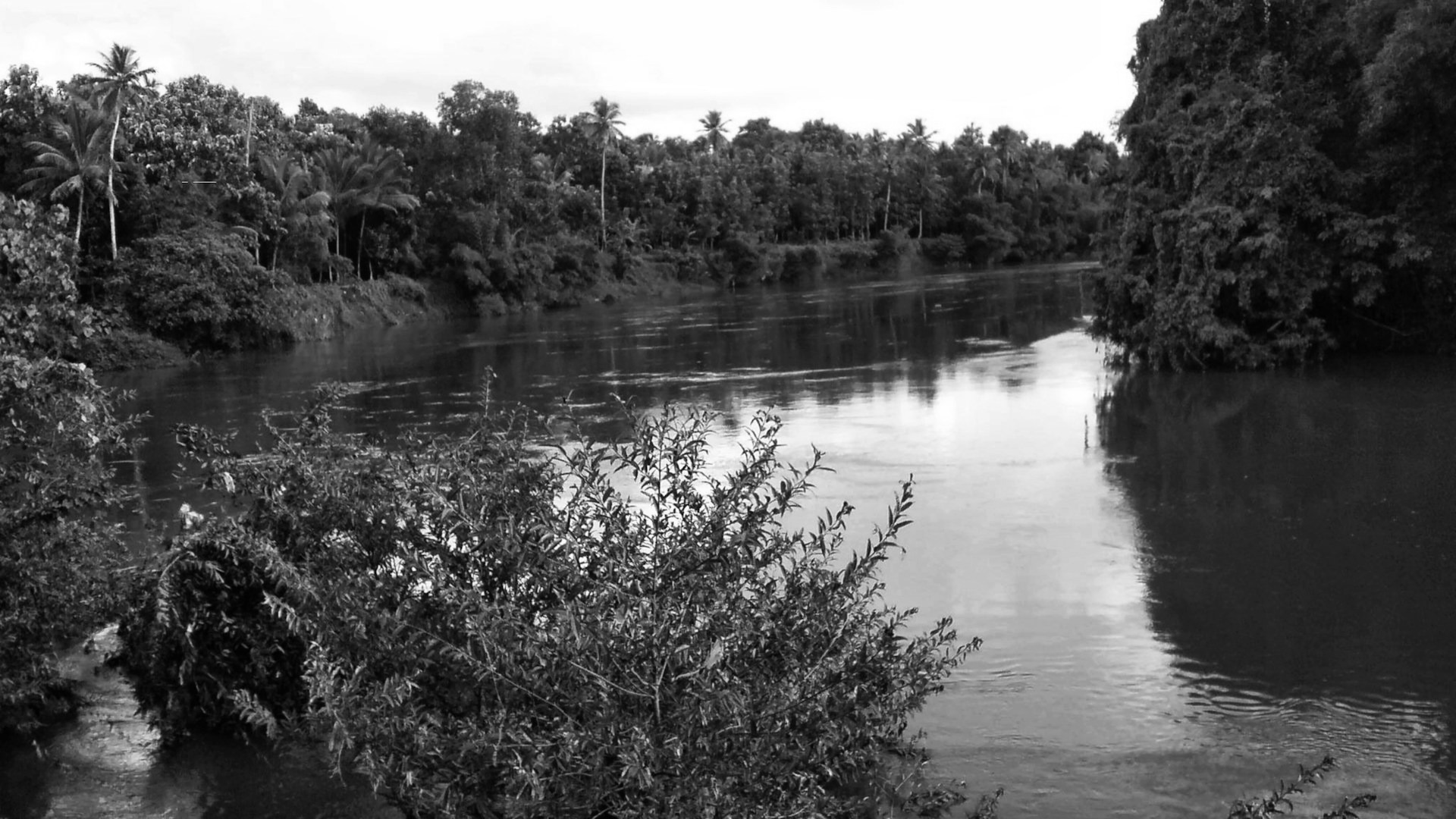
Kelum often wandered down to the river where the whispers of the servants couldn’t follow him. He skipped stones, swam with the water snakes and pursued the little black snails across the slippery rocks. He could go where he wanted now – no one in his family would come looking for him. But he didn’t know if he wanted to go anywhere anymore.
One day, Kelum went to the bend in the river, the place from where the water veered to the left and out of sight, dipping below the pine-crested plateau he had come to think of as the End of the World.
He had been tempted to go beyond several times, but his Seeya’s hysterical German song was a manacle on his ankle. The last time he had left the estate was the last time he remembered any of his family looking into his eyes when they spoke to him.
He stepped lightly off the overhanging rock and let the chilly roiling water take him.
He heard the song in his ears, even now.
The further he floated, the louder the music grew, and he did not recognise it to be Seeya’s song.
As he floated into a rocky basin, he saw a fish almost as big as a nine-year-old boy, scales glistening rose-gold in the dappled sun as he danced in the water.
“Who are you?”
“Dance with me.”
They twirled together; boy and fish, hand and fin.
The music swelled, and other fish joined them in their dance, respectfully keeping a distance.
“Who are you?” Kelum asked the fish again, coughing up a lungful of water.
“I am the King of the Fishes. Who are you?”
“I thought I knew, but I don’t anymore.”
“Ah,” said the King of the Fishes, “But I do.”
And he began to sing.
Once upon a time, in the Kingdom of Kandy,
A child was born of prophecy.
Blood of conquerors, kings of old,
Oceans blue breath and highland rain.
There was no cheer within the court,
For the destined new heir,
For their fear grew that treasure untold,
Would slip their grasp beyond compare.
The fear grew throughout the halls.
As the king had the child claimed,
The courtiers schemed, in shadows hid,
Against this magic untamed.
In the dead of night, on moonstone steps,
The courtiers spilled her red, red blood.
No cavern of jewels opened, no kingdom’s might,
Just echoes of innocence and a king’s lament.
But the spirit of the child rose high,
A curse befell all of the land.
For ever a firstborn child of firstborns.
Their blood be magic, their soul be key,
To bring out treasures untold.
***
That was the reason?
A legend, a myth, an old wives’ tale like the ones the washerwomen and vegetable vendors spill on the back kitchen steps on Sunday mornings, next to dollops of betel leaf juice and spittle?
Maybe his father and mother should never have married.
Maybe Kelum should never have been born.
Kelum dragged his wet body to the nearest rock and crawled out, leaving newly formed little rivers behind him.
He didn’t feel very special anymore.
The King of the Fishes followed him to the edge, only his big pink head bobbing out of the water like a floating pumpkin.
“You are not pleased.”
Kelum shook his head, causing a small rainstorm for the snails sharing the rock with him.
The King of the Fishes twirled twice and plucked a rose-gold scale from behind his gills. He beckoned Kelum to him and placed it in his open palm.
All the other fish were watching, gills gasping for air, single, beady eyes fixed on Kelum as he sat on the warm rock, blinking thoughtfully at the scale.
There was a book in Aththa’s prized library, a clothbound edition published in 1871 with an inscription that read, To my wife, all my love. Cambridge, 1878.
It was the story of a girl named Alice who was also all alone in a house full of many other people.
Until one day she found a mirror that she could step through into a world full of the most wonderful friends.
The fish in the background began to hum a lullaby.
It reminded Kelum of his mother’s voice when he was a baby.
“Come with us,” the King of the Fishes crooned. “Come with us.”
Kelum held the scale to the pad of his index finger, hissing a bit as it created a new red line between the lines that would form his fingerprint. Blood bloomed, like the roses at the top of Aththa’s garden, when she would hound the gardener to water them, before Seeya started singing in German.
Kelum watched a drop of crimson fall onto the wet rock, mingling with the river spray, turning a pink that reminded him of Mister Peacock. He wondered if it was blood or a tear.
With a nondescript belch, the rock slid forward, revealing a gaping cavity.
The humming of the fish turned into a song as they gyrated around Kelum and the cave, in alternating circles, each assembly line picking up a thread of the harmony.
“Come with us.” The King of the Fishes roared with laughter and caught Kelum by his cut finger, leaping into the cavern in a spray of diamonds and rose-gold.
The song the fish sang grew louder and louder as Kelum plunged into the cavern.
It seemed to extend in front of him, blinks of light spiralling into aquamarine and ruby-red.
Pulsing in time to his quickening heartbeat.
Images buzzed past him as he fell. He missed the first few but managed to angle his body to catch every other as they flickered in the opposite direction.
A beautiful younger version of his mother, her thick, curly hair bouncing behind her like a halo of obsidian and copper as she ran down the mossy steps, zigzagging between tea bushes to where his father waited at the foot of the field, his arms wide, his smile wider.
She crashed into him, and they went tumbling into the bushes. He was saying something to her, but before Kelum heard what it was, the image was whisked away.
He reached desperately, grasping fingers towards the moving picture of his parents.
The next image appeared on his right. He twisted his body around to look directly into a pair of eyes as melty brown as he had seen his own in Aththa’s big wardrobe mirror.
“Aiya!” called the unknown voice of his little sister. He knew she had existed, inwardly at least, until the day he went up to the Badrawati with the saadhu. On that day, his grandfather was not the only family member Kelum lost.
Tears wicked off his eyelashes and flew up the cavern, away from him and towards the river, where it would join the flowing water of the land Kelum inherited.
The image of his grandfather with an elephant gun propped on his wide shoulder caught Kelum’s attention, but before he could focus on Seeya, a golden beam shone directly on his irises, temporarily blinding him. Kelum tried to cover his eyes with his hands, but the friction of the fall was too strong.
The light grew brighter still, an impossibility.
There were shapes dancing in the midst of the glow. Like fingers beckoning.
Kelum closed his eyes and spread out his arms. He knew how this story went.
There was a land beyond the looking glass.