
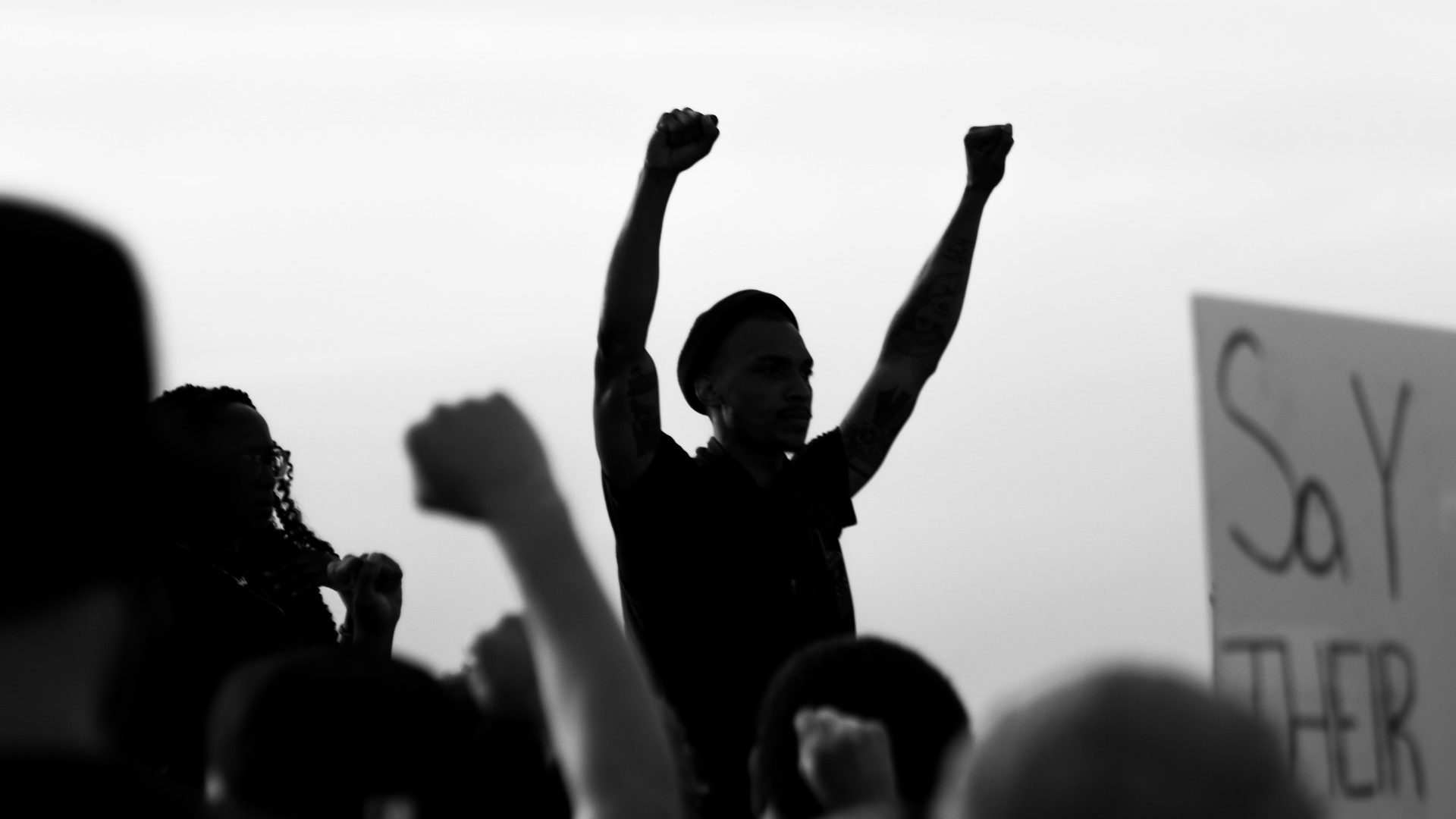
Narrow Walkways and Still, Grey Puddles
by Wakonyo Ayeko Gachanja
The sound of a cock crowing pierces through the thick blanket of silence.
My eyes snap themselves awake, looking for a fixed point of familiarity. On the chair slightly to my left is my outfit for the day. Black sweatpants. Black t-shirt. Black hoodie. Black sneakers. My courage. Today is the day. Its enormity wears itself on my person, an oily slickness, unseen and potent.
I quickly change into my ‘uniform’ and prepare my breakfast of ugali, eggs and spinach. I will need my energy today. My mother sits on a stool just outside the front door, the jagged edge of the tin roof jutting outwards just enough to provide shelter against the sun’s glare. She angles her head upwards, tilting back her neck to look at me, storing the shape of my eyes somewhere at the back of her memory. She opens her mouth, as if to say something, but the words escape her before she can make a sound. Reaching under the neck of her oversized blouse, she searches under the cup of her bra beside the strap of her left shoulder and hands me something. 500 shillings. Enough for almost a week’s food. She gets up and walks back into the house before I can protest, and I hear the tinkling sounds of cutlery being washed in a basin.
Making my way to the city centre, I weave my way through narrow walkways and still, grey puddles, the pungent smell of sewage sticking to my hair and clothes. I pass by a group of young boys, passing around a football made of brown bags wrapped inside a plastic bag and sisal rope. I stop by and offer a wave, catching the ball with my foot and dribbling it one, two, three, four times. I pass the ball to a scrawny boy wearing torn blue shorts and a white vest, continuing on my way. The journey is about an hour away from home on foot, and I arrive at my destination with a light coat of sweat beading my forehead, dust adhering to the black surface of my sneakers.
It’s still early, and in the city centre, it is business as usual, except for the increased number of policemen, as is expected. I duck my head downwards, rounding my shoulders forward to shrink myself, to seem less threatening. Eyes fixed to the rhythmic cadence of my feet, I head briskly towards our designated meeting point.
***
The first thing I see is a placard that reads, WE ARE THE FUTURE YOU ARE CURRENTLY DESTROYING. Ondiek is by the side of it, doing some stretches. “Mutiso,” he says by way of greeting, “Let’s jog on the spot to warm up”. I join him eagerly, needing to dissipate some of the nervous energy that has been gathering like clouds preparing for a storm. By the time Mwangi joins us, we have worked up a clean sweat, and there are more people in the city centre carrying placards. One simply says WILL YOU TAX OUR AIR NEXT? Another reads, STOP KILLING US FOR SPEAKING UP. There is a palpable nervousness in the air, an anticipatory collective buzz. Most faces are young, the brightness of youth preserved in rounded cheeks and confident, upright strides. People are clustered in small groups, in varying levels of frenzied excitement.
Slowly but surely, the crowds gather. The sounds of chants and whistles begin to announce themselves in the air. We join up with a group of ladies who stand by the corner of a street, looking lost and overwhelmed. Their relief is evident when we introduce ourselves and explain that we’re also here for the protests. Soon, we’re bumping shoulders with people we don’t know, as we head towards the government buildings on the other side of town. It’s impossible to ignore the air of anticipation colouring the protest.
Suddenly, a loud pop interrupts the loud chants of protest, and the group just in front of us turn back and scatter. Instinctively, we do the same, and I turn back as I run, eyes taking in someone in a ski mask kicking what seems to be a tear gas canister back to the police officers that threw it in the first place. The kick is quick and accurate, as if practised before. By this mysterious stranger stands another individual, grasping a tennis racket tightly.
My heart is a puddle in my shoes as we continue on. The crowd swells larger and larger the closer we get to our destination, growing like a single-celled living organism of giant proportions. Soon, the wide roads are filled with people, the police officers overwhelmed, and something unidentifiable swells in my throat, finding its way to my chest. The flower of hope blooms somewhere where my lungs should be. All these people…
A march for our future, a march for our country. The chants gaining rhythm and momentum, the heartbeat of a tired youth, all united against selfishness and greed. A lump of an emotion I have difficulty identifying swells in my throat. We’re almost there, we’re getting th–
BANG!
The sound cuts through the cacophonous sounds of the crowd. A split second. The crowd ahead of me instinctively ducks, my legs buckle, and I’m on my back in an instant. Numbness, then a searing pain across my middle. I reach my hand towards my abdomen, my fingers finding a sticky wetness. I raise them to my face, and I’m met with digits painted red. Wait. WAIT. This wasn’t supposed to happen.
As my vision slowly dims, I’m taken back to the narrow walkways and still grey puddles of home where my mother sits patiently, waiting for me.