
Lessons
by Kathryn Kulpa
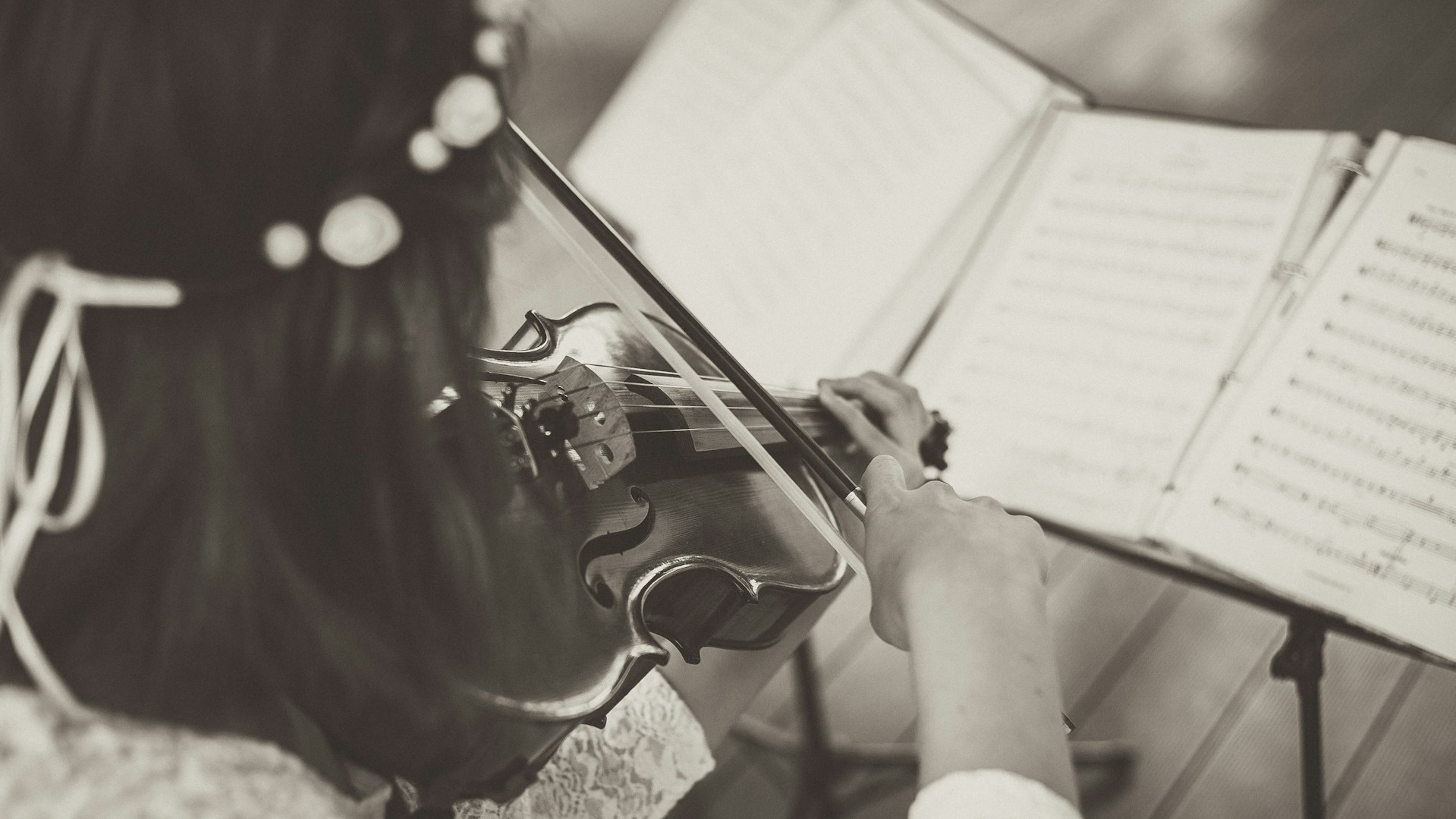
Once, before she was my mother, my mother played violin in a local orchestra. She kept her instrument, took it out at holiday parties, her hands gliding the bow over the strings with magical quickness, chin proud, elbow bent just so. In fourth grade, our school offered free music lessons to anyone who wanted them, and of course, I volunteered, eager to be discovered, to be a “child prodigy,” like a girl in a mystery story I’d read. That girl was nine years old and filled symphony halls all through the world. She was also a miserable brat and got herself kidnapped, but still. The power she held in those violin-playing hands!
At first, when my mother gave me her old violin, I was thrilled to imagine that power thrumming in my hands and everything about the instrument – the oil-polished wood, the crushed red velvet of the violin case with its cutout bed for the violin and all the mysterious compartments, tabs you pulled to open a hidden box with rosin the colour of earwax – promised passage to a mysterious new world.
The actual lessons were a study in disappointment. I hadn’t expected the first lesson to be no playing at all, only memorizing the parts of the violin, with a quiz afterwards (C+ “Lack of Attention!”). I hadn’t expected a teacher who’d poke my fingers and rap my elbow with a ruler, ask if I’d left my brains on a bus. I hadn’t expected a music book where the only song I recognized, “Turkey in the Straw,” was one I didn’t like. Most of all, I hadn’t expected the dismal, squeaking sounds that came from my humbled, ruler-rapped fingers.
Wednesdays, the day of lessons, became a weekly agony I’d do anything to avoid: playing sick, claiming I had to stay for extra help in math, passing obvious notes in class so I’d get detention. In detention, we had to “write the dictionary,” copying down definitions from the old, brown-bound Webster’s until an hour was up. Even that was better than violin lessons.
Back then, all my favourite literary heroines wore puffed sleeves and hoop skirts. Like Anne of Green Gables, I longed to experience an actual swoon; I sobbed at Beth’s tragic demise in Little Women, and sometimes, when feeling wronged by the world, imagined them all feeling sorry when I died young of some unnamed ailment. Or at least, appeared likely to. One fateful Wednesday, I worked baby powder into my face with my mother’s compact sponge, making myself look pale and wan, surely too sick to go to school, surely too frail to stay after for music lessons – too weak to do anything but lie abed while a devoted Marmee brought me Mallomars on my favourite yellow plate, and nibble them delicately while watching reruns of I Love Lucy and Bewitched.
Only I’d failed to notice the sift of powder down my red flannel nightgown, and when I tried to croak out “I feel faint” my mother pointed to the tell-tale trail and asked what did I think I was doing with her powder, had I seen the rug, I was going to vacuum up every bit of that mess – and then I cried, not fake tears but real ones that left ugly snail trails in my powder-paste face, and I told her how I hated my violin teacher, Mrs. Valente, how she called me a tail-dragger and a lollygagger and stood over me with her ruler ready, so I was afraid to move my hands at all.
My mother sat me down on the bed. She sat beside me and wiped the damp powder from my face. She said Mrs. Valente had spoken to her about me.
“Did she say I’m a poky little puppy?” I asked. “A lazy bones?”
My mother shook her head, lips tight, like she was playing the clarinet. “She said you were not musically inclined.”
I thought of all the times my mother and I sang together, in the car, or in the garden or working around the house, and I wondered if it hurt having to listen to my unmusical voice. I asked if that meant we couldn’t sing anymore, and she said we could sing whenever we wanted, and that Mrs. Valente was a mean old –
“What?” I asked, hoping to learn a new swear word.
“A big bassoon.”
“She went to Juilliard,” I said, a fact Mrs. Valente shared with her students often.
“She doesn’t know anything about teaching.”
My mother made a terse, blistering call to Mrs. Valente. My violin days were over. My dreams of being a prodigy faded with them, becoming a faint musical murmur from another room, shuffling feet, woodwind vibrations, jangle of strings being tuned. Everyone was waiting, like me, for the show to start. Or perhaps only waiting for the program to change. Waiting for the next thing to happen.
One response to “Lessons by Kathryn Kulpa”
I have taught Flute lessons for over 50 years. I have learned that when a student needs to stand on her head in the middle of a lesson I let her and then we get on with it. I thought she was going to quit because she has “no musical talent” but she has stayed with me eight years now.