
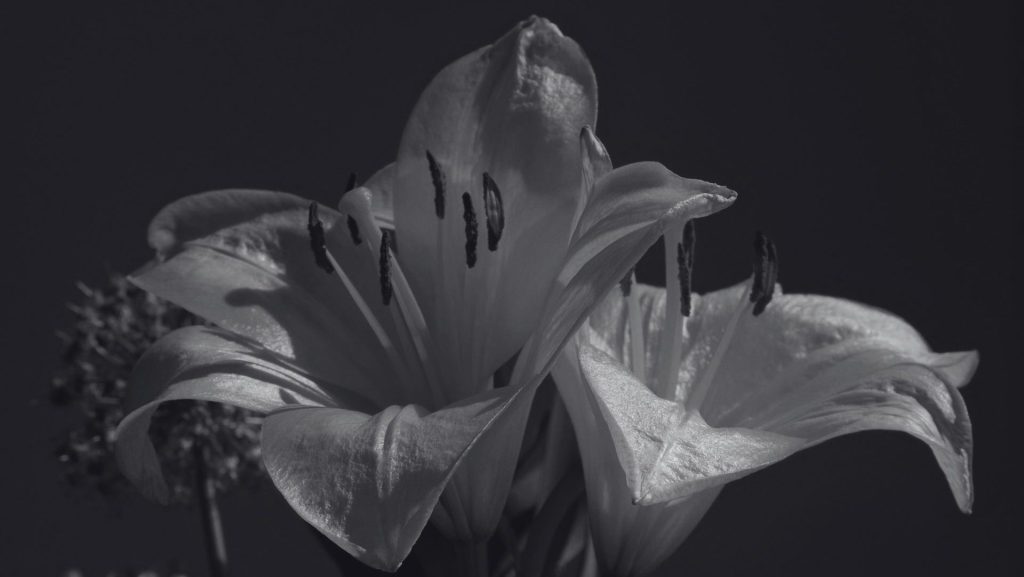
Where the Flowers Go
by Franklin Obiekwe
When my grandmother died, I had to deal with the deep distress that comes with having something close to your heart taken from you, the distress of losing something special. I lived with this woman for six years, perhaps more, and within those years of living with her, I learned a great deal from and about her.
Sometimes I think she would have, perhaps, lived a little longer than she did, had she not spent most of her nights deep in silent worry.
I recall the day she came – or, more precisely, the day she was dragged to our doorstep, forced into our home. As he urged Grandma forward, Uncle Jerry, my mother’s brother, yelled, “She can’t stay with me anymore… I am fed up!” in a voice that brooked neither interruption nor argument. He kept pounding on our door with an irate fist until Chidimma opened up with more force than needed to open a door. I made to join her in what seemed a brewing confrontation, but she stopped me with one hand. I hid behind the curtains and peeped through the shutters, which offered me a manageable view of the scene playing out outside. I heard Chidimma’s angry voice asking Uncle Jerry why the hell he wanted to break down our door.
He ignored the question and repeated that Grandma could no longer stay with him. His forehead pooled with perspiration as he volleyed such furious rants. He was tired of cleaning up her shit every single day, he said, tired of sleeping on the couch because of her, tired of providing for his five children and his wife, plus Grandma. It was draining him mentally, financially, constitutionally. It was high time it fell to Chidimma’s lot to look after Grandma.
Before Chidimma could say anything in response, Uncle Jerry tossed Grandma’s luggage to the ground, as though it were some trash, and left. Grandma turned to face Chidimma. “Nwam, my daughter,” she said, in a voice so guttural yet so soft. “Don’t mind him. You know how he is. Ignore his anger, i nu?” She stretched out her arms in a beaming invitation to an embrace. But I saw it, the way Chidimma rudely recoiled, dodged Grandma’s open arms, and walked away with a grimace embedded in her face. It shocked me. But this was only a taste of what was to come. I ran outside and welcomed Grandma to the house.
***
The first few days were bumpy. It seemed that I was the only one happy with Grandma living with us. Why Chidimma was repulsed by Grandma’s presence remained lost on me. As for my father, Tunde, he threatened to leave the house if Grandma stayed. But he kept returning home every night. Chidimma tried to damp down his boastful exasperation; she kept saying that they had no other option, let Grandma just stay a few days or weeks before they sorted things out. Tunde expressed his displeasure by calling Grandma names. One night, he said if Uncle Jerry could not look after the “old bat,” there was no way he or any of us could. He needed privacy here, not a burden. I jumped in while he was still speaking, and said, “Tunde, why don’t you mind your language, and pull yourself together?” This statement barely had a second to settle well in the room before the fierceness of his callused hand struck my face. “Why don’t you, Kate, mind your own business and go to your room?” he said, glaring down at me. “And for the last time, don’t call me by my name. I’m your father, not your damn mate!”
Limply, I cupped my face, smarting from the slap. I felt the prickle of welling tears in my eyes, threatening to flood the room in one abrupt outburst. I sniffed and looked at my mother. She looked back at me—a vacuous glance bereft of pity—shook her head as if nothing had happened, then looked away.
“I hate you two!” I screamed and dashed out of their sight. By the time I reached my room and seated myself on the edge of the bed, I had begun crying.
***
It was Grandma who taught me how to prepare egusi soup. “Cooking this soup,” she had said, “requires a good deal of your attention lest it burn. It’s quite different from other soups, you see. You have to let the egusi boil very well and get done to a turn – otherwise, it will upset your stomach. No, no – the ugu has to come in last so it still retains its rich nutrients. Go easy on the salt. Those onions are too coarse; dice them much smaller. A sparing amount of pepper will suffice…”
She would go on to teach me to cook ogbono, and oha, and ofe onugbo. Prior to this teaching, the only thing I knew how to cook was noodles. My boiled yams were always mushy. My jollof rice was too salty. As for Chidimma, she was a terrible cook, which is rather paradoxical, because she worked in a restaurant.
***
Grandma usually regaled me with stories, most of which were about the tortoise and his cunning ways, and why today he has a broken shell. I liked listening to her stories, the quiet lessons they bore; I liked listening to the gentleness of her voice, too, and always felt soothed by the euphony of her Igbo.
One night, after dinner, she asked me why I called my parents by their names. We were lying on the creaky bed in the small room we shared. Moonlight streamed in through the window and cast a rather faint oblong on the tiled floor.
“Is anything wrong with that, Grandma?” I asked.
“I didn’t say there was anything wrong with it, Nneoma.” Grandma was the only person who ever called me by my Igbo name.
“It’s just… not very common in our part of the world.”
“I learned it from a book.”
“From a book? Which book is that?”
“It’s a book called To Kill a Mockingbird,” I said. “We read it in our class last term. It’s an interesting book, Grandma. The two children in the book call their father by his name.”
She chuckled. “So, you’re doing it because they did?”
“Yes,” I said. “And because I like it, too.”
“Well, Nneoma, it’s not exactly a wrong thing. But, sometimes, you also have to call your parents what they are to you – your mother and father. Just like you call me Grandma, see? It has the power to bring a family closer.”
I nodded. After a while, I said, “Can I ask you a question, Grandma?”
“Of course, my daughter.”
“Why– ” A thick string of uncertainty looped round my tongue. I heaved a sigh, pressed on. “Why does Chidimma – my mother, I mean – treat you the way she treats you? Why isn’t she nice to you? And my father? And Uncle Jerry? Why?”
Grandma looked at me. From the dim moonlight, I caught a small, weak smile on her lips. “Uncle Jerry is nice to me,” she said. “He just has a lot on his plate.”
“Okay, let’s leave Uncle Jerry. What about Chidimma and Tunde? What about my parents?”
Grandma was quiet for a moment. “I didn’t hold with your mother marrying your father,” she said. “He used to be a smoker, notorious for excessive drinking and reckless lifestyle. I wanted the best for your mother and had advised against her marrying him. She took it amiss and said I didn’t wish her well and other things that weren’t in fact true. She left with your father and started living with him. I was alone for a few years. When I fell sick, I couldn’t do much for myself anymore and needed someone to stay with. So I went to your uncle’s home. And now I’m here.”
“Grandma, do you mean to tell me that it’s just because of this she’s been unkind to you? For this long? I honestly don’t appreciate how she treats you. I cannot in good conscience be comfortable with what she does in this house.”
“It’s the path she’s taken, and with her eyes open. I’m sure she’ll be able to handle whatever comes of it. You shouldn’t let that bother you.” Grandma smiled again. “Each man has his life to live. It’s left for him the kind he chooses. I see a lot of potential in you, Nneoma. And I’m sure you’ll make the right decisions in life.”
Silence hung in the air for a good while, except for the chirps of cicadas piercing the night along with the intermittent croaking of frogs in the nearby reeking swamp. Grandma’s gentle words sank into the depths of my mind.
I looked at her to see if she had fallen asleep. But her eyes were still open. They seemed unblinking. Her hand rested wearily on her forehead as she gazed into the black nothingness of the ceiling.
“Maybe I’ll tell you about the To Kill a Mockingbird story some other time, Grandma,” I said.
I saw her shake, rather convulsively, like one held by a seizure. This told me that the sound of my voice had startled her out of something. Perhaps a deep, deep thought.
***
I regret that I never got to tell Grandma about the story before she passed. It was a quiet death. She slept and did not wake up the following morning. She had suffered from diabetes for months before. Much as we tried treating it – or tried giving her what we thought was treatment – the disease kept on being a serious disturbance, a menace to her health. Her continence deteriorated more than before. Her appetite gradually eroded. She grew reticent as time went on, signifying her responses with either a nod or a toss of her head, telling me fewer or no stories at all. Wound after wound etched themselves on her legs like scrawled hieroglyphics on a wall. It was as if she were decaying before all of us. The one time we had taken her to the hospital, the doctor prescribed a drug we failed to get for her. Chidimma had said she was broke; Tunde promised to land a hot slap on anyone who asked him for money. Grandma had merely subsisted on a cheap herbal drink a neighbour recommended.
I remember running into my parents’ room that morning in blind panic, screaming, “Grandma won’t wake up! We need to get her to the hospital right now!” before Tunde did something that, whenever I think about it, always breaks my heart. He refused to take Grandma to the hospital on the bus he used for public transport. He claimed it was faulty, the bus, and that the mechanic needed to fix the carburettor. Though aware that I had very little cognisance of them, he deliberately used words like carburettor, radiator, crankshaft, camshaft and whatnot, to lend some sort of credence to his claim. I was no automobile engineer, but I was certain that there was nothing wrong with the bus that morning.
Chidimma, too, displayed negligence, only that she deigned to take a look at Grandma. It galled me to hear her say Grandma was only still sleeping. “Keep your voice down, and stop worrying yourself for no reason, Kate.”
***
“She’s not breathing, Chidimma!” I yelled. “Have you checked the time? Grandma does not sleep this long!” After all my failed efforts to get her and Tunde to believe me, I went to the kitchen and brought out a knife from the drawer. I stood in front of them, pointing the knife at my chest. I threatened to stab myself and die with Grandma if no one listened to me. They both thought I was bluffing and told me as much. Tunde ignored me and set about preparing to leave (with his faulty bus). I held the knife in my tremulous right hand and cut my left with it. Blood began pouring out without delay.
“Jesus, Kate, have you gone crazy?” Chidimma shouted. “Throw that knife away now!”
“Not until someone takes Grandma to the hospital.”
I saw terror spreading all over her face. Tunde made to lunge at me and snatch the knife out of my hand. “Stay away from me!” He kept edging closer. I held the knife, more firmly this time, and cut myself again. As blood gushed from these cuts, so did tears from my eyes.
“Kate, stop!” Tunde bawled. “What is wrong with you? Stop this now!”
“I won’t, until someone takes Grandma to the hospital! She’s not breathing there! She’s dying! You two can’t just sit here and do nothing about it!”
“Fine! We’ll do something!” Chidimma said. “Just stop this nonsense. You’re hurting yourself for Christ’s sake!”
***
While Grandma’s death shattered me and substantially wrecked my world, it did not seem to move Tunde and Chidimma. Barely a week later, I heard Chidimma moaning loudly in their bedroom while Tunde shoved himself inside her like one possessed. For days, I starved myself and cried myself to sleep for many nights. No one took any notice of my grief and desolation. No one. Not even the people who were supposed to be my beloved, caring parents. Perhaps I lied to Grandma about why I called them by their names, rather than the nne and nna she suggested. Perhaps I called them by their names because they were undeserving of being called mother and father. They did not care about me; they still carried on with their lives with gay abandon, as though nothing had happened. Chidimma had wanted to abort me when she got pregnant. She had done several abortions before my conception. Grandma told me this – after I promised not to breathe a word about it to anyone. I had come differently, she said, unnoticeably. By the time Chidimma realised she was pregnant – and wanted to have an abortion – it was too late. My secret knowledge of this brought home Chidimma’s wonted proclivity for carefree cruelty. This secret knowledge brought onto my tongue what tasted like hate.
***
Grandma liked lilies. I had seen her show interest in them those evenings when we went for walks down the street. When we stumbled across one, she would gaze at it, entranced, and remark on how beautiful it looked. We would pluck the little flower and draw in the exquisiteness of its fragrance.
It was for this reason that I began going to the cemetery, soon after her death, to drop lilies on her grave. I went every Sunday evening without fail, on my return from church. I had taken a teaching job and was now making some money myself. The scars from those cuts still sprawled on my hand; they reminded me of her whenever I looked at them. Visiting Grandma’s grave grew to become something of a ritual, a solid article of faith to which my life was now cleft. It was my way of connecting with her, my way of reliving the moments I shared with her. It came to teach me something I had not known.
Something about the eternity of love. It doesn’t stop just because someone is gone. It continues and just learns new ways to arrive. I had thought Grandma’s love would go with her, but quickly realised that my coming here still offered me her love, just a different version of it.
One day, Tunde told me I was wasting money buying flowers for someone already dead. What was the point of buying them if the wind would blow and sweep the flowers away? I had felt a creeping impulse to get angry at him for saying this. But I quickly checked myself and chose instead to ignore him. It was something he would never in his life understand. Had his bus not just recently sustained heavy (actual) damage that cost an arm and a leg for repair? He was little more than jobless now without the bus. I understood that he was merely trying to coax me into giving him the money I spent on flowers. This understanding encouraged me all the more to put my anger aside.
When Grandma’s birthday came, I bought a cake and left a chunk of it on her grave. Ants came and feasted on it. No problem, let them celebrate, too. Since I have no one to call, no one to invite, no one with a genuine interest in this little ritual of mine, let them join in this perfect blend of mirth and sorrow, this solemn remembrance of a noble woman who gave meaning to my life.
 WENSUM