
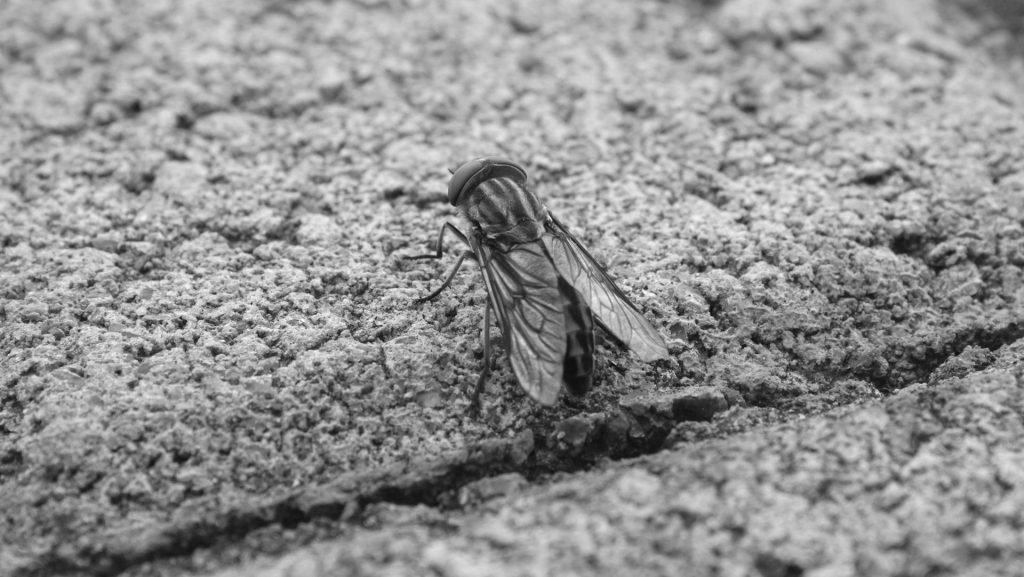
Horseflies
by Sam Christie
For once, there were choices available for Pisgah and me. I mean, they were all pretty bloody horrible, but at least we had a choice of how horrible. This would be a day spent doing the least worst thing, so we turned our attention to factors such as energy levels, fuel costs, the preservation of life, limb and the terrain upon which we might toil.
You see, there were sites all over this grand pastoral canvas that were part of someone’s utopia, and it always astounded me that realising the vision of professional ecologists fell to Pisgah and me. Someone had to do it, and it was work where work was scarce.
We were wearing damp chainsaw trousers on board a 2004 Renault Traffic, parked in an upland lay-by.
“What we doing then, boi?”
Pisgah was idly scrolling, only half-engaged with his question. I rolled a cigarette and glanced at my watch: 08:30hrs.
“There’s strimming the entrances, clearing up that oak by Llanilar or doing the drainage ditches.”
“Fuck the oak. Too hot for oak,” he put down his phone and turned. “Strimming. That’s the one. We need a good strim.”
The van smelt of egg and oil. I wondered why Pisgah had so many broken pens lying in the grimy dust on his dashboard. I wound down the window and contemplated work.
Our activities were distinct, involving different parts of the body and appealing to particular emotions. The use of a chainsaw meant activating the lower arms and twisting the back frequently. The noise – raucous – locked you in and made the world a solipsistic affair, observed behind the wire mesh of a helmet visor. Everything moved fast with chainsaws, as if the rapid cycle of the razor-sharp chain needed to be matched by the pace of the work. The chainsaw shouted its orders, which sometimes had a place, but not on a hot day when the heavy armoured trousers would stick to your thighs and overheat your balls.
Digging out ditches was the opposite experience, involving long, loping strolls down endless footpaths with mattock or shovel slung casually over the shoulder. It also involved tourists, lead-less dogs and a raging tedium that linked the day to the slow rotation of the sun in a way that felt almost physically intimate. I knew what Pisgah wanted; he sought the sweeping meditation of the strimming. He wanted to shuffle along, whisking the plastic string through the long grass in satisfying arcs.
“I’m in,” I said.
We both had skin in the game of these hills. Many of the trees or fence lines held experiences for us, and Pisgah could rightfully see each bit of undulating horizon as very much a part of who he was. Pisgah was called Pisgah because he was from Pisgah, so as we passed through his village, I saw its metal sign in two ways. While I could not speak for him, I’m sure he also noticed how memories of the land had changed as the work we did trampled them, replacing the Polaroids of childhood with the scent of two-stroke fuel, sweat and the knowledge of money.
“Do you feel old?” I asked as we drove past the Halfway Inn, which now had decking and a National Trust-style paint job.
“I’m feeling this heat, but I still don’t have children, so yes and no.”
“Would you say you’d reached the stage where policemen actually do look younger?”
“The last time I got close to one was when I was thirty, so who knows? You can only guess that sort of thing here.”
We were doing the aprons of the forestry entrances – long sweeping lawns that joined the huge steel gates to the verges of the road. Strimming them pleased the dog walkers and the mountain bikers but vexed the ecologists who insisted we leave the thick banks of nettles that at this time of year swarmed with butterflies and demented bees. Whenever we talked of strimming the aprons, I thought of those women in old photos wearing traditional Welsh dress, some of whom, I’m told, smoked pipes and wore hobnail boots.
At the site, Pisgah frantically stalked around the van, sliding and slamming doors. The man looked like a bit part in a Breughel painting. No matter the fact that his woollen, cape-like jacket was top of the range, it still resembled the smock of a medieval jester. Out of the corner of my eye, he appeared like a windsock in a gale or perhaps a frantic, pointy nightcap. Pisgah could not be separated from who he was, a man of this ground.
After a swift procrastination of tea, we got to the business of setting up – cranking allen keys, unravelling yellow plastic string, gurgling fuel, sharp exclamations and the delicate business of adjusting harnesses. In order for us to get to a fully zen-like strimming condition, a correctly adjusted harness was crucial. The machine needed to balance like the sphere of a ship’s compass on a gimbal, hanging just right with the weight well distributed across the body.
“And to the bloody grass!” Pisgah yelled after tugging his strimmer to life.
He stomped away, flinging on his goggles and snapping his ear defenders down. I sighed and started to walk to my section, mentally measuring how long this might take. Grabbing the handles of my machine, I guided the head to the long grass and started to scythe.
After perhaps a minute, the job melted into a bearable process of thinking on idle thoughts and noticing sensations in the body. It was true that as the grass gradually cleared, a diligent person could conceivably derive a modicum of satisfaction from the task. Like any job, if unfettered, the operator might reasonably afford themselves the thought that their lot was not as bad as they imagined after all. As I calmed into the day, my almost-reverie was cut short by a yell.
“Dog shit!”
Pisgah lurched and darted, brushing frantically at his smock. His strimmer lay discarded on the grass. I cut my engine and watched, knowing exactly what had happened.
“I went in too fucking low. Bastard fucking dogs! Shit everywhere here.” His goggles were peppered with brown spots.
At times like these, you were lucky if you couldn’t taste the stuff in your mouth. What made this worse was that if you got zapped by a stray turd, your clothes might hold the scent for weeks. Pisgah looked emotional and hung his head.
“This job. This job. Christ!” he waved his fist in the air, speaking to a God I wasn’t sure he believed in.
I noticed today that Pisgah had altered, like a suddenly crooked smile. Something had shifted in him, broken even. I realised it was down to me to bring him back. We had all been there.
“Get a cloth. Cup of tea. Regroup.”
I put my hand on his shoulder in as manly a way as I could; a little firm slap but not too firm – distance but with feeling. Pisgah turned and looked directly at me, but neither he nor I could change any of it. We both lived somewhere in our heads during these days, and I was always amazed when anyone suggested there could be any romance in the work. We all took daily journeys of resentment, sorrow and memory. In our minds, we reached towards the circling buzzards or maybe the cities that were hundreds of miles away.
“Nah, fuck it. Same shit, different day, boi.”
He wrenched at his starter cord, and the two-stroke Husqvarna popped once again. Striding away to the next tangles of last year’s grass, he revved away the realities.
I was swinging the machine back and forth, staring at the moss-covered Sitka spruce, when I felt the first bite. Not a sting as such, but more of a burn. Unmistakable. On the back of my arm was what looked like a tube of fag ash, just hanging there. Where there was one horsefly, many were sure to follow. I slapped it away, but it coiled around and squared up for another run, seeking to land again. It had already bitten, so the chances that I’d have a swollen arm the next day were high. You couldn’t detect them until they bit, and by that point, you’d already have an itchy sore that would keep you awake, that you’d claw at for weeks until smooth scabs and sore lumps would cover your body and render you walking wounded.
In the summer, people get bitten by horseflies every day. Horseflies are miserable, disastrous and almost worse than serious injury, but you can’t stop work for a horsefly, who’d accept that? We were the tree people, the rugged workers of the woods; van drivers with a three-day growth on our chins. We drank, grinned, bellowed and smelt of sweat and softwood forests. But the horseflies didn’t stop coming. Even if you swiped and ran, they followed, locked like Exocet missiles with blood on whatever passed for nostrils.
As I wheeled my arms and slapped at my face, the clouds of little grey monsters grew around my head. They buzzed with a low-frequency purr, and occasionally I felt the odd one land on my neck, face, or arms. I looked around and noticed Pisgah was sitting totally motionless in the van, and it was at this point I decided to make a run for it. I had never seen so many in all my years.
I was cackling as I crashed into the van and slammed the door with a clang. Pisgah was staring out of the window and was not blinking. He sat like a yoga teacher with his hands resting on his legs and back rigid.
“Err, that’s quite a few horseflies then, mate.” There was no reply from Pisgah, or any discernible movement.
“Never seen them like that. So many like that.”
A large cloud of them bustled in front of the van, hanging in a pulsing ball over the bonnet. I stared at them, and my amusement started to abate. There was, it seemed, an unnatural amount of the things, a ridiculous quantity.
“Pisgah?”
He dropped his head and closed his eyes, breathing out in a hiss.
“Dogshit, biting flies, sweat, chainsaws, and nobody knows we’re here. It’ll be the same tomorrow and the next,” he spoke to his legs and screwed his eyes more tightly shut.
“Never any change. Well, what else could I do? Leave this place, I suppose. This is what we must accept. Accept.” Pisgah had started to knead his hands into a tight ball.
The flies had thickened in a swirling vortex in front of the van. I had an idea, but it wasn’t a good one. I dug my phone from my pocket and started to search the internet.
“Perhaps there’s something to like about them? Almost all creatures have some amazing quality after all.”
Pisgah had returned to his upright sitting position and had resumed staring at the cloud. Wikipedia provided a pretty comprehensive overview.
“According to this, these things are known as Tabanidae. They are from something called a Diptera.”
There didn’t, at first, seem like much to recommend them.
“Ahh, but here, here. It’s only the females that bite. See! We’re being chased by females. Desired, even though we look like this.”
“Women, you say?” Pisgah talked quietly.
“Well, okay. They’re mentioned in Shakespeare! Gadfly. So even those old school types in pantaloons were enduring this. We are not alone, my friend – we’re in significant literary company. Look, look, they’re the fastest flying insects. Ninety miles per hour they can go.”
A few flies had started to bounce off the windscreen, as if they were trying to break in.
“They pollinate. They provide food for lots of other things. Good for the environment.”
“Ahh, yes, the environment,” Pisgah spoke as if hypnotised.
I had begun to run dry of other points. Aside from being useful in the disposal of bodies, flies seemed only to serve the purpose of being food for other creatures and getting on everything else’s nerves.
“They can talk.”
Pisgah swung his head around. “Fuck off!” he exclaimed.
“Okay, fair enough, but they’re good at acrobatics according to this.”
“Your argument is very thin for an educated man.” Pisgah rolled the r in very.
As we sat with the windows tightly closed, I noticed the ball of hellish monsters starting to dissipate. It seemed as if the assault might now be at an end as they could no longer detect us in the atmosphere.
“They’re going,” I said.
“They’ll be back soon enough.”
Pisgah wound down the window a crack.
“Listen, you have to learn to see them in a better light. Remember some of the good things: women, Shakespeare, fast.”
A lone horsefly hummed through the gap in the window and settled on the windscreen directly in front of Pisgah.
“Never!!” Pisgah punched forward explosively at the horsefly with such force that the windscreen shattered in a maze of cracks.
The fly dropped onto the dashboard and lay upside down. I held my breath and tried to calculate the cost and process of replacing the glass; this had turned out to be expensive retribution. An initial assessment suggested that disposing of one horsefly had cost about five hundred pounds.
In the ensuing silence, the fly moved a wing, shifted with a little buzz and flipped over. Before either of us could do anything, it exited through the window and was gone.”
 WENSUM
One response to “Horseflies by Sam Christie”
Great story, very well described.
LikeLike