
You Can Stop Crying Now
by Molly Corlett
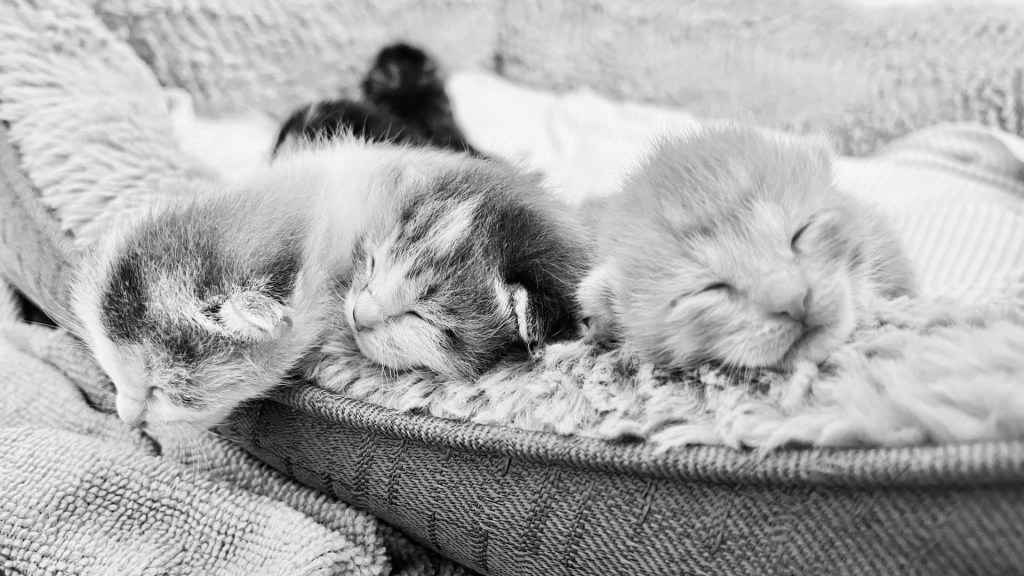
Yesterday, I met a litter of kittens that couldn’t yet see or walk. I think there were five of them. My daughter picked one up by the neck like the cat mothers do, except that she did it with the rough tenderness of a child, and it made the real mother hiss. I thought of you as I watched the manhandling and the hissing, and that evening – don’t judge me too much for this – I shut myself in the bathroom and sobbed. My husband took over without questioning anything, which made me feel even worse. I sat on the rim of the bathtub, head in hands, and listened to him doing the parenting. I hated him, at that moment, for being so capable. I tried to tell myself that, in a world where my daughter’s school only ever reaches out to me, even though I have sent them my husband’s contact details at least three times, it is a feminist act to be the less competent parent. Then I thought about you again, and about your mother who couldn’t take care of you, and about my mother who didn’t want to take care of me. I got hold of myself after that. I couldn’t tell you exactly what motivated me. It might have been principle, or it might have been plain old fear.
I don’t think you’d like the family we were calling on, the owners of the kittens. I don’t like them much. A year ago, the council tried to turn the house on the corner into a children’s home, and that family wouldn’t stand for it. They knocked on every door and asked every neighbour to tell the council: No thank you, we don’t want those children anywhere near our children. Sorry, but not sorry. I thought about you that day, too. I told them I wouldn’t be signing or sending anything, argued even though I knew it was pointless, sat right down on the floor when they’d gone away. I felt so guilty and so powerless. I only moved when my daughter came into the hallway to see what was going on, and then I had to pretend that I’d hurt my ankle and had sat down for a minute to rest. She was so sweet about it. She fetched a whole pile of cushions, arranged them around me, patted heavily at my hair. Then she told me I would be OK. It scared me a little, the way she behaved. She must have got it from her dad. I was never kind or thoughtful like that. You remember what I was like as a seven-year-old.
On the way back from our neighbour’s house, my daughter asked if we could take one of the kittens. She had a look on her face like she’d been struck by genius. They had five kittens and didn’t want to keep them all; we had zero kittens; it was simple arithmetic. I told her that it was a lot of responsibility, and that she needed to prove, first, that she was serious about it. I told her that she had to start with something smaller, maybe a fish. I told her that I’d shared a pet with my sister once, and it hadn’t worked out so well. I didn’t explain the context (I don’t know if you remember that brief, unworkable period when my sister and I swapped between our parents’ houses every week, and I had all the wrong things with me at school). I didn’t say: “I nearly killed my sister’s hamster when I was around your age. My best friend and I kept laughing at how sluggish and wobbly he’d got, and then he stopped moving at all.” I don’t think we realised he had no food. Children can’t always put things together like that. Honestly, it’s something I struggle with even now. I don’t mean that I might accidentally starve my daughter – obviously, there is nothing like that. But I still have that feeling, often, of only seeing in retrospect how an action was bound to lead to a consequence. I’ll hold a glass sideways and find myself startled when the water tips out. I’ll set my keys down on the kitchen table and decide to keep them there. Ten minutes later, on the bus with my daughter, I’ll realise that I haven’t locked the door. A good mother would never fail to lock the door.
***
I forgot to tell you what made me sob in the bathroom yesterday. Sometimes I cry blankly, with nothing at all in my head. I don’t mind that. It’s almost a relief, like having a bad dream about anxieties that don’t properly belong to you, rather than the anxieties you’ve been trapped with in the day. Last night, for example, I dreamed that I had to cut down a tree that was blocking my neighbour’s window. A whole crowd of people were watching me, but my arms weren’t strong enough. I was getting nowhere, but I wouldn’t allow myself to stop. That was OK to wake up from. I could let it go easily enough.
Yesterday, though, my mind wasn’t blank. I was thinking about the way children are with animals, and dolls, and even small babies, and how that instinct was always missing in me. It made me remember a day towards the end of our friendship, not too long before I moved. We were in our den in the park, scratched and stung all over by the effort of climbing in. You insisted on keeping the den right in the middle of the bushes, so that it was hidden and painful to get to. We only relocated once that year, when someone with nowhere else to go put a tent up in our spot, and we made our way back to it as soon as they were gone. We recognised it by the blue carrier bag that you’d tied around the lowest branch of our tree, and the pile of objects that we’d buried in a big pile of dirt and leaves: a bracelet, that broken kettle, some rusty car keys, a supermarket loyalty card, the wheel from an office chair.
That day, a pigeon was lying on top of our treasure hoard. It had this unstable, disjointed walk, and it kept trying to pick itself up before losing its balance and sinking back down to the ground. I don’t know if they need their legs to fly, or if the wings were damaged too. I bet you would remember that.
I started out by shouting at the pigeon, in deliberate imitation of the way I’d seen you shout at the people who lived nearby. I think I said: “WHAT’S YOUR PROBLEM THEN?” Standing there in my chewed-up cardigan sleeves, doing the world’s worst impression of someone hard. I was never bold like you. You’d strut right up to the houses at the edge of the park, the big houses, and you’d brandish the kettle and yell out instructions for them. “PUT A BREW ON FOR US,” you’d shout, and they’d pretend that they couldn’t hear. Well, there was that one old lady who inched outside, now and then, to tell us off. The others complained behind our backs. It wasn’t too wise of us, maybe, going right after school in our uniform.
That was how my mum found us, you know, when we ran away. She rang up the school, and the receptionist remembered those complaints.
Anyway, you didn’t shout at the pigeon. You cared for it. You wrapped it up in leaves – it flapped a little but couldn’t move its disjointed limbs quickly enough to resist – and you held it like a doll in your hands. I can hear you now, saying the kind of thing adults say to make a kid shut up. Something like shush or never mind. Speaking in that exaggerated child voice, the same way my daughter spoke to the kittens yesterday, as if you were performing what care looked like to someone who had never seen it before. That day, as always, I was your audience. You set the pigeon down in that parcel of leaves, and at intervals all through that afternoon, you stopped what you were doing and crouched over the nest you’d made. You gave me updates on its health each time, and I took for granted that you knew best.
“You’re all better,” you told the pigeon, before we left. “You can stop crying now.”
The pigeon wasn’t crying, but that didn’t matter – you didn’t mean it literally. I wonder, looking back, who you were pretending to be. Maybe it was the woman you lived with, the one whose relationship to your mother I could never figure out. Was it her daughter, or her sister, or her niece, the woman she didn’t manage to keep away? Who was it that she lost you for?
***
Of course, I don’t know what happened afterwards. I was the one who got sent away; you might have stayed where you were. I only know what you told me, a few weeks after nursing the pigeon, about why we had to run away. (We never saw the pigeon again – I’m only realising that now. You must have been right about it recovering.) You said that your mother had come to see you when she wasn’t allowed to, and that you and her and your auntie or great-auntie or gran – whoever that woman was – were in trouble because of it. You said that this kind of trouble might mean going to another home and another school. You said that you had already left three schools. Maybe that’s why our teachers put you into the bottom set for everything, even though you were smarter than the top-set kids, who only did well because their parents made them get the answers right.
I’d tried to invite you to my sister’s birthday party that year, and my mum had vetoed it. I wonder if you knew that it came from her. I probably lied about it at the time. I know I should have been angry at the injustice to you, but I wasn’t. I was angry at the injustice to me. Here’s the thing about that veto: it was my sister’s party, not mine, which you weren’t allowed to crash. My mum would have uninvited me from that party if she’d thought she could get away with it. It was my sister, only my sister, who she wanted to protect.
I fought back that time. I pleaded your case to my dad – you were the only real friend I had, and I was hardly going to sit around with kids my sister’s age for the whole party – and he called up and argued on my behalf. My mum took the call in the kitchen, and I sat on the stairs and listened to her. She paced the room as she talked to my dad, irritated, as usual, by the way he talked to her and by his little conspiracies with me. She didn’t lower her voice.
“That whole family is known to services,” she said.
I guessed that she meant you were in trouble with the police, and I had that in my head, still, when you started talking about doing a runner. I was going to be like a criminal from a TV drama. If my mum wanted to believe that I was naughty, I would show her by becoming really bad.
I remember the way she looked at me when they found us – when she strode up to her own tent, stolen from her garage and inspired by the person who had slept in our den earlier that year, and we crawled out and admitted defeat. She took me to one side and wept tears of frustration, not relief. I think she was holding herself back from smacking me.
“Your sister just doesn’t behave like this,” she shouted. She kept shaking her head, as if she couldn’t believe that she had created and brought up a person as bad as me. That was all she ever said about us running away, on the day or afterwards. A reminder that there was something specifically wrong with me.
I would have picked you over my mum if anyone had given me that choice. I thought that you were magical. You made me feel like I could be bigger, braver, without everyone hating me for it. It had been a hard year for me. We didn’t talk about that in the same way that we didn’t talk about your home life. I wouldn’t have known how to start. But my parents had given up on the old arrangement, where each of them had one week with one child and then one week with the other. It had been a bad system – I lost homework and random belongings and my PE kit every weekend – but I guess they saw it as mathematically fair. My mum asked me what I thought should happen, the Christmas before they stopped sending us from house to house, and I came up with another symmetrical idea: I would live with my dad, and my sister would live with my mum. My mum walked right out of the room when I said that. She didn’t want to live with me, not really, but she couldn’t stand the idea of me not needing her. In the new year, my sister and I switched to living with my mum and seeing my dad on alternate weekends. I wished they’d never asked me anything.
You probably know that I moved to my dad’s house, permanently, after we ran away and got found. Once, when I was at university – it might even have been my graduation week – my mum asked me if I had ruined my life with her deliberately, so that I could be with him. That was how scheming she thought I was, as an eight-year-old. I spent years judging her for viewing her child that way. But there was a day that my daughter, at the age of maybe two or three, looked me straight in the face and said: “I like Daddy and I don’t like you.” My stomach twisted, and for hours, for a whole afternoon, I thought of her as some kind of demon child. My husband had to talk me into seeing it as a normal statement for a toddler to throw out at a parent, and not as proof of something badly, irretrievably wrong with either her or me. I still think that she might have meant it. She said it midway through the year, when everything went wrong.
Anyway, that afternoon, I started to understand why my own mother acted the way she did. Something was badly wrong with one of us, she could see that. She had to believe that it was me.
***
I tricked myself into seeing you at the school gates today, crouching down and speaking to a small girl I didn’t recognise. I stepped towards you and almost said your name. Then that other woman stood up, and I was startled to find that she was a stranger with a round face – not sharp like yours – and bright, friendly eyes. It was strange to confuse two people that way, at my age. I was a lost child in a supermarket for a moment, tugging at the wrong adult’s coat.
My daughter flung herself at me before I could make sense of my mistake. But now, lying here in the dark and not sleeping, I wonder if this compulsive need to remember you is making me worse. All the other school-gate mums are grounded in their routines, rightly consumed by them, and here I am routinely slipping out of my own life.
I got to the school thinking of you – that was the problem. I’d tried to open the website with your name on that afternoon, and like always, something in me had panicked and closed the window before it could fully load. I’ve never kept it open long enough to study the photograph. It might not be you. It’s a common name. I didn’t expect to find anything when I searched for it.
I don’t think there is much to learn from that site, even if I could stop myself from closing it. When I opened it the first time, I read only one sentence out of the three or four. It said: Your Wings Were Ready, Our Hearts Were Not. Someday, I’ll stay on that page for long enough to learn whose hearts it is referring to. I hope it’s a family that you created for yourself. But I read that one sentence and got this phantom memory of you, as a child, dressed like an angel. (It can’t be a real memory: I don’t remember any Nativity plays in our school, and, if we did have them, I can’t imagine the teachers choosing you.)
My daughter was cast as an angel a few years ago. I watched three tutorials online and pieced together an old pillowcase for the body, cut-up paper plates for the wings, gold pipe cleaners for the halo on top. There was no sewing, and I did it so patiently and neatly that I shocked myself. It took me back to the kind of mother I’d been at the start, in the pre-lockdown days. You should have seen me back when I was good. You wouldn’t have recognised me. I promise you, for the first six months of my daughter’s life, I was everything you are meant to be. I was a blur of laundry and feeding and pumping and changing and rocking and soothing. I knew everything and either did or delegated every detail of her care. If I had to leave her with my husband or my sister, I wrote down a long list of instructions and texted every half hour to check what was happening. I used to snap at my husband, sometimes, for his absent-mindedness. And yet here we are.
I guess you’ll be wondering what happened – how I got back to the bad version of me. I think the turning point was the summer of 2020, when people started acting halfway normal again, and my daughter lost her mind. If anyone came within a two-metre radius of her, or me, or my husband, she would devote every inch of her little lungs to shrieking at them. It wasn’t your usual two-year-old tantrum scream: it was more like a human car alarm. She believed, wholeheartedly, that any passing stranger might drag us into the apocalypse. She refused to go back to the way things had been before, and so I stayed in limbo, too. We fell into a pattern, day by day. Outdoors, my daughter raised the alarm and then clung to me, desperately, without calming down at all. Indoors, I handed her over to my husband, retreated into our bedroom, and wept. These days –
***
I’m looking at my life through my memories of you, seeing it refracted back to me all wrong, when my daughter edges into the kitchen and upturns my thoughts. She stands there, quietly and unhappily, without saying what she wants. She’s close to tears, and she won’t tell me why. She won’t talk, but she doesn’t leave, she needs something, she can’t find the words for what – I stop peeling and chopping – I reach out to her. She snaps at me, but then she gives in and starts sobbing against my leg. I turn the oven off.
My daughter tells me about a girl at school who is meant to be her friend, a girl who has stolen her best friend away. The intruder girl has come up with a new game: she tips over the Tupperware box of grapes, which my husband packs as a healthy snack, and she stamps on them one by one. I see the split skins on the floor and my daughter’s face – puckering like a baby – the shame and confusion and indignity of it. I hold my daughter and stroke her hair. Her breathing gets less shallow, her face less hot –
***
I don’t tell you, as I was planning to, that – these days – my husband leaves the instructions for me. Instead, I ask him to take over the meal when he gets home, so that I can stay with our daughter. Together, we assemble the loose pieces of her Lego Minecraft set into a pirate ship. She hands me blocks and solemnly scrutinises our work, but every so often she pauses and leans against my side.
“When I was your age, I had to move away from my best friend,” I tell her, while we are building. “Her name was Sonia. Have I ever told you about her?”
My daughter considers this, then shakes her head.
“She was very imaginative, just like you,” I say. “We used to have a den in the park near your gran’s house, and we’d play there every day after school.”
I am braced for a question about the move. But instead, my daughter asks, “What did you play?”
“We used to make up a lot of different games. Once” – I am looking at her Lego set – “we climbed very high up into a tree and pretended we were on the mast of a ship.”
I picture you, perched at least five branches higher than me, threatening to throw yourself down to the water-that-was-really-the-ground and laughing at the panic on my face. Shouting: DON’T WORRY, I CAN SWIM.
“That bit goes on top! You’ve done it wrong!”
I remove the piece and correct it. “Sorry, sweetheart,” I say. “I got distracted for a minute.”
 WENSUM