
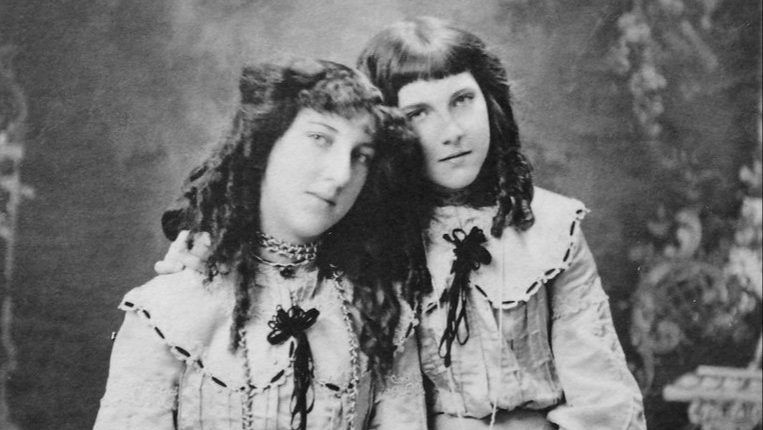
An Unexpected Meeting
by Sara Jane Green
I’d seen her several times before, this woman. Loitering on the steps to our small shopping plaza down the road, wild-eyed in Miller Street, its river of traffic churning around her through canyons of high-rise office blocks, peering into plate glass windows, advertising cellulose injections and other horrors, her expression suggesting the Martians had landed. Each time, her head jerked up and she seemed to stare at me. I’d noticed her walking down our street too, glancing at our house. Which wasn’t so unusual. People often did, especially after dark with the hall lights on, when richly coloured leadlight bejewelled the front door. Ours was one of nine Federation houses in a small Conservation Area, saved from developers in the 1970s by local heritage orders. In 1908, when they were built, they would have gazed over pristine bushland. Now they faced down a mishmash of Californian bungalows and blocks of flats of the featureless 1940s Australian blocky variety, so our front door was a cinematic moment in the gloom. To the south and east, our small pocket held back the tide of steel and glass, which was the North Sydney business area.
But this was more than glancing. Once, I thought she might come in the gate. I smiled and stood, waiting, trowel in hand, and worrying where our overly territorial cattle dog, Saskia, might be, but the woman dipped her head and walked on. She stood out because her clothes and comportment were of another era – a more elegant time of cloche hats, flapper dresses and tortoiseshell cigarette holders, but anything goes in fashion these days. Sometimes she removed her gloves and studied her hands. Sometimes she stood like a mannequin, hands clasped in front of her, or trailed one along our picket fence. I thought she might be waiting for someone, idling the time away. Her hat covered darkish bobbed hair – and it was a cloche hat. I briefly saw almond eyes, an arched nose and thin red lips. Something prickled in my memory.
When I passed her down at Lavender Bay, as Saskia and I went for our morning walk, I had to say something. This was becoming creepy.
“Hello!” I said, a smiley note to my voice. “We seem to keep running into each other.” Saskia paid not the slightest heed and headed for the tiny beach between the old slipway timbers, used for launching boats in decades long gone. It was a favourite seagull-chasing and swimming spot.
The woman turned sharply, as if I’d caught her doing something she shouldn’t.
“Oh,” she said. “It is you.” Her tone had a slight sourness that I recognised from phone calls with my mother, when we weren’t getting on. Her speech was clipped and plummy, very British, as if she were reading the news on the wireless in the 1940s.
“Yes? Have we… met? You do look familiar.” I became uncertain and awkward, but then it is awkward if someone remembers you, but you don’t remember them.
Today, she wore a wide-brimmed hat, and it was flapping like a seagull in the breeze, which always blew off the water down here. She put up a hand to steady it, and my eye caught a flash of something that made my jaw drop.
“No, we’ve never met,” she said. “But I think you’re getting the idea.”
I consider myself a logical, rational person, some leftover childhood superstition still ingrained perhaps – salt over the shoulder for luck, things go in threes – but, on the whole, not given to fancies. Jabbing had started just below my sternum, and my legs sagged as if I’d run a marathon. I staggered back several steps.
“This… this can’t be real,” I stammered.
“It may not be real, young lady, but then again, what is?” She said it almost sarcastically. As if I was supposed to understand.
Just then, Saskia appeared. She raced up and did what she always does after a swim and a roll in the sand. She shook herself all over us.
“Oh, my God!” the woman said with some disgust, flicking at her clothing, though she did not seem to be wet.
“Sorry, sorry,” I said, grabbing at Saskia’s collar to stop her doing it again. “Saskia, come here.” Saskia gave me a wounded look. Usually, she got a treat for coming back.
“So, you’ve worked it out at last,” the woman said. She removed her hat rather than keeping it pinned to her head and ran the fingers of her free right hand through her hair to settle any strays. And we stared at each other.
My chest was pounding, my mouth like sandpaper. Some jet stream had lifted me off my feet and was tossing me around. One side of my brain said this was not possible, the other was looking straight into her eyes. My gaze flicked down to her left hand, the one now holding her hat, where she wore a large, shiny diamond cluster ring, with a plump amethyst in the middle. The very ring which I had inherited from my mother – her mother’s engagement ring – and which was sitting upstairs in my jewellery box.
“Dor… Dorice?” I squeaked out.
“Is there anywhere to go and have a cup of tea?” she demanded. “I want a word with you.” My guts contracted. “I don’t recognise this place at all,” she said. “We used to come down on the trolley bus and sit and watch the sunset. There was only the private ferry stop then. It used to be so delightfully peaceful here. Just water lapping and the night calls of the gulls. None of this.” She waved her hand in the general direction of everything – the gawdy lights and blaring tunes of the Luna Park funfair; the City skyline, a glittering bar chart, catching the morning sun; the great arc of the Harbour Bridge, rumbling with commuter trains. “Although they were building that big ugly bridge. Made such a mess of the shoreline.”
We panted our way up the steps from the foreshore to Lavender Street, Dorice complaining all the way. Saskia, too, was being obstructive. This was not the way we usually came. We stopped for breath at the top, then followed the bitumen path, past strangely turreted houses on our left and, opposite, Wendy Whiteley’s Garden, an oasis of secret paths, lush trees and plants, a space wrangled from the Railway Authority, which had previously gardened weeds and rusted machinery there. Wendy’s was a much better foreground to one of the postcard views of Sydney Harbour.
“What on earth are those?” Dorice said, snootily, as we passed by some huge Gymea lilies. They were in bloom, their russet-red mop-headed flowers towering over us on thick spikes. “I thought I’d seen everything in Cape Town.”
Seated at an outdoor table at LouLou’s bakery and café, my shaking hand passed Dorice a menu. I still wasn’t breathing with a regular rhythm, although coming up those steps had not helped. Saskia loves cafés, but when we go for brunch, my husband, Nigel, brings her breakfast. She put her head in my lap expectantly. I had nothing for her.
“God!” said Dorice. “What is all this? Can’t one get a simple cup of tea nowadays?” She re-interrogated the menu.
“Um… English Breakfast is probably the closest to… um… what you’re used to,” I said, the unreality of this conversation bringing back the jet stream – but, as I said it, it struck me. Could ghosts drink tea? Would it leak out? Would people run screaming from the café? Several of the yummy mummies were already eyeing us strangely.
“That which,” she snorted. “That to which you are used.” And I remembered Mum taking off her mother’s habit of correcting her children’s speech with very rounded vowels. “And you call yourself a writer!”
“I… I have to go to the counter to order, Gra… um… Dorice.” I didn’t know what to call her. Yes, technically, she was my grandmother, but I knew her best as a lengthy research project and protagonist of the book I’d written.
“Well, you’ll have to pay. I don’t have any money. Oh, hold on, I might have a shilling in my reticule.” I hadn’t even considered payment. Fortunately, I kept some small notes and coins in my dog bag, and I had my iPhone – if I could make the payment thing work.
“It’s dollars and cents now,” I said, as she fossicked in her purse. Dorice looked up at me as if I had banged the table and shouted in her face: one did not contradict one’s elders in my family. “Can you hold Saskia for me?” I hastened on, and I gave her the lead.
I went in and ordered her tea and a black coffee for me. I asked about some water for Saskia. They said they’d bring it all. I almost laughed when the waitress asked if I wanted soy, almond or oat milk with the tea, but I stopped myself because I could feel a huge hyena laugh building. Hysteria was not far away.
“Oh, no dogs inside,” said the waitress, giving me a bug-eyed look that said Are you stupid or what? I spun round. Saskia had followed me into the café. So ghosts could not hold dog leads. Now I really started to worry about the tea.
“I must say, you paint me in a rather nasty light,” said Dorice, as soon as I got back to the table. “More so at the latter end of this… book. You make us out to be a couple of trollops, and you’re telling people I lied in court. I don’t like it at all. You’ve made it all up.”
I blinked several times at her assault.
“Well… yes… I’ve made it up. I wasn’t there, I wasn’t born yet.” I kept my voice steady as if it were a perfectly normal thing to say. What I wanted to say – no, shout – was ‘Well, weren’t you? Loose women, trollops, by the standards of your day? Or even today! Not that I’m being judgmental or anything, but… You and your sister, Hilda, buggered off in 1922 to Africa and Australia, leaving your husbands and six young children behind – my mother wasn’t even three years old, for Christ’s sake. Those children never understood what they’d done to make you go. It scarred them for life. And while the family bought your story that you were honouring your late father, ‘following in his footsteps’, seeing the extraordinary places he’d lived in and explored, I discovered that you both sailed off with lovers in tow! Obviously, it was a thousand times worse because Hilda was murdered. And then, you, Dorice, didn’t tell your own family the whole story, why it happened. Of course, they knew that Hilda was dead, but not the rest, and then you deserted them again to go and live in Africa with another man, and now you want to be painted nicely.’
But instead, I said, “How come you’re…um… here. Talking to me, I mean.”
She set her face in that way Mum did when displeased, chin jutting with accusation.
“Hilda said I should. She said you didn’t know what you were saying in this opus of yours. She comes out alright, but you really weren’t kind to me.”
“So you see her? There’s some sort of afterlife?” I gasped.
The waitress arrived just then, so Dorice didn’t answer. The waitress glanced at me and put both the coffee and tea down in front of me. I looked up at her, perplexed. “I’m bringing the dog bowl in a minute,” she said, plainly thinking me unreasonable.
“Uh… thanks,” I said. Good job I didn’t come here often. A deep breath was what I needed, but my chest was still pumping to its own agenda. I passed Dorice’s little teapot and cup over to her, the teaspoon jingling like sleigh bells on the saucer.
“You see Hilda?” I prompted.
“Oh yes,” she said. “She went straight to Cloud 9. Because she was murdered. But I had some explaining to do.” Quite unwarranted, her face said. “Because I killed myself – but I was ill, I had good cause. Even so, we suicides aren’t supposed to have such an easy time of it. Hilda spoke up for me. I think St Peter is sweet on her, but she’s with Hori, so he keeps his distance.” I almost fell off my chair.
St Peter? Hori? I was beginning to doubt my sanity. “Hori? Hori! They’re ‘together’… up there? But he killed her. Isn’t she a bit pissed off with him?”
“Really, young lady! Language! It seems it was Love after all. He still swears it was an accident. He thinks your book is marvellous, loved it all – not that I think he’s much of a reading man – but then you do rather take his side. He can’t believe you knew about him studying in prison, and that you met his eldest son.” I was too astonished to even try to explain the internet when Dorice picked up the little Japanese-style tea pot and poured.
“God, you have to make your own tea now. For Heaven’s sake!” She added milk from the tiny jug, stirred daintily, then picked up the cup. I forgot to breathe.
“Hilda was so very touched that you renewed her grave license. She’s your Number Two fan,” she said. Then, sharply, “What are you staring at?” My lips moved, but nothing came out, so she continued.
“And that you went all the way over to Adelaide to find her in the first place. She loved the bit about you lacking a grave-cleaning kit and your husband cleaning her up with his old underpants. That’s her kind of humour.” I flashed back to that day in a dusty Adelaide cemetery. During my research phase, we had driven some 1600 kilometres to trudge up the lines of gravestones, obelisks and statuary, like a visit to a macabre garden centre. The map from the Cemetery Authority pinpointed Hilda’s grave site, but they didn’t know if there was a headstone. In 1924, why would Dorice have spent money on a headstone when it was so unlikely anyone from our family in England would visit? No one did, as far as I know, until I turned up eighty-three years later.
“It’s quite a monument, Dorice.” I managed to say. “The obelisk and pink granite slabs. It’s still in great condition. But I didn’t understand the epitaph, Here in the Unquestioning Earth, She Rests. Not unless…”
“Yes, of course, I was sick of questions, “ she tossed her head, angry. “As you wrote. No one believed a word I said about that wretched man. He did pester her. He did threaten her. Thought she was his property. I was just trying to have the last word.”
“Can Hori hear you now?” I asked, voice hushed.
“Oh, I suppose he can. He knows what I think.” She sipped her tea. I almost leapt across the table with a serviette. Saskia was chewing a bit of bark that had blown under the table. The yummy mummies were engrossed in gossip. An older man in the corner kept glancing in our direction, but he shook his paper and looked away when I caught his eye. And nothing happened.
“Is something the matter?” Dorice demanded. “You don’t seem very relaxed in my company.”
“Well, I… it’s not every day…” I broke off lamely.
“Oh, do pull yourself together. St Peter didn’t altogether approve of my coming to see you, but then he didn’t forbid it either. Why do men still think they run everything? You modern girls don’t put up with that. Mind you, you’re not proving to be what I expected. After all the research you’ve done on us. I thought you’d find me fascinating.” Dorice sounded like she was going in for the attack again.
“Dorice,” I hissed. “I’m not sure whether other people can see you. So they think I’m talking to myself and drinking tea and coffee. I don’t know if they see your tea cup hovering in the air – although I guess they’d be screaming by now.”
“Oh, I see,” she said, and laughed. “I suppose you have a point.” She put down the cup.
“Well, can they see you?” I asked.
“I’ve no idea,” she said. “Let’s see, shall we?” and before I could stop her, she slapped the table and hooted with laughter. Saskia looked at me sharply. Could she see Dorice? She hadn’t reacted down at Lavender Bay. But no one else turned a hair. Saskia whimpered, but it was a ‘Where’s my breakfast? Are we there yet?’ sort of whimper.
Then Dorice held out her arm and dropped the little milk jug on the paved floor. It shattered. Everyone looked up. Had the mad woman who chattered to herself and couldn’t decide between drinks finally shown her true colours?
“Jesus, Dorice,” I hissed again. The waitress came dashing out with a dustpan. “I’m so sorry,” I said. “I’ll pay for it.” The waitress looked grumpy but said, “I’m sure it was an accident,” and swept back into the café with the bits.
“OK,” I said, more firmly than I felt. “That’s enough.”
Some writers say their characters never leave them, but I was rather hoping this one would. When my blink ended, she was gone. For minutes, I sat as stone, questioning whether it had happened at all, but the deep red lipstick on her cup told a story. It was a shade I would never wear.
 WENSUM