
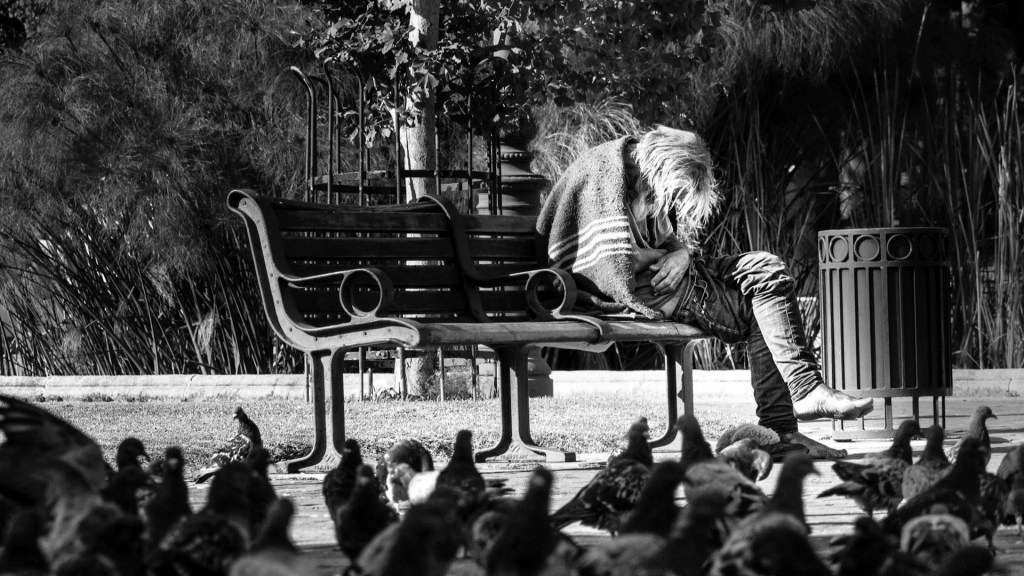
The Women in My Life
by Tim Love
I’ve been on this park bench since the gates opened, trying to work out if the woman opposite is an old mother or a glamorous gran. Then the baby she’s holding cries, and she unbuttons her blouse to suckle it. I bow my head so she doesn’t think I’m staring. Her drinks can falls, which makes things easy for me. I pick it up for her, saying don’t open it now, it’ll squirt all over you.
She introduces herself as Liz, a painter. I’ve always wanted to mix with arty people rather than nurses. When I ask her what she’s currently working on, she says: “47 Lancaster Terrace.” She switches the baby to her other side, tells me how she’d got a grant to do a street mural. The house is due for demolition. She’s going to video the mural’s destruction and enter it in competitions. Seems pointless to me. I look at the can because I’m not supposed to gaze at women. I’ve learned to sneak little glances and join them up later.
I pop a pill. Tersipan’s horrible stuff. Gives you hallucinations. I have to sleep with my head pointing North to straighten my brain cells. I’ve found out that Magnetic North moves at 40 miles a year. It’s heading straight for me now. I know it’s my turn to say something. My bedroom needs decorating for a start.
She’s calling her project ‘Entitled’ – like ‘Untitled’ but for the homeless. She’s never thought of home as a safe place. Her mother used to put clothes out for her every morning except on holidays when she could decide for herself. They’d been about to go away for a week. She was seven and chose her sparkly fairy outfit. Her mother told her that the holiday hadn’t yet begun. They drove off without her. She sat on the stairs for a while, then started filling carrier bags with her belongings, wondering where to go. Half an hour later her father opened the front door. “Ready Liz? She’ll only wait a minute for you to change,” he said.”Am I adopted?” she replied.
“It’s that sense of impermanence I want to convey,” she says. I nod. I could have sworn she had a baby with her. Maybe the crying I heard was me. I tell her that my sister phoned this morning. Her daughter had run away, saying she’d decided after talking to me. “Why, Mark?” my sister said, “Why did you make her go?” I wracked my brains to remember when we’d last spoken. It was Boxing Day at a boring family do. I was drunk, sitting in the garden, having a quiet smoke. I didn’t hear her creep up behind me. When she said: “Cold?” I jumped. We had a laugh about how Jake’s girlfriends all look like boys, about Susan’s multi-colour hair, and how Milly talks about nothing except her diet, which was obviously failing again. She asked if I had a spare cigarette. I gave her my last one, reluctantly. She lit it from mine, took a long drag. We sat there looking at the stars. “Crap, ain’t it,” she said, waving her cigarette towards the house, “You know, everything.” I looked back. Through the French windows, I saw a room crowded with people. “School ok?” I said to break the silence. I knew she was a bright kid. She shrugged, waving the cigarette like it was a sparkler. Or was it a wand? “Thanks for listening, Uncle Mark,” she said, “I know it’s not been easy for you since your mother died.” I didn’t want her to hug me so I rushed in to get another drink. She didn’t follow.
Maybe I said all this to Liz or maybe I just thought it. She’s staring at me as if she knows it all anyway. I’ve heard about women like her, do-gooders who want to help the homeless. She fiddles with the buttons on her blouse. I’m not homeless. I bury my head in my hands and give it a shake. Why is everything my fault? Life’s tough enough as it is. I try so hard. I always take my pills. I brush my teeth twice a day. I don’t stare at things I’m not supposed to see.
I look up and she’s gone, like all the rest. They talk and talk, then walk the talk without a word. I’m not going to chase them. It’s too nice here. There’s a bandstand, whitewashed now, but I’ve seen pictures of it painted like a fairground roundabout. The trees have labels with long names like Harry Potter curses. There’s a path for the blind, with Braille signs telling them what they can smell. I can smell what they smell. My father comes round to say that the park’s about to close. It’s his job now to take me home. He never lets me down.
 WENSUM